Menu

Menu
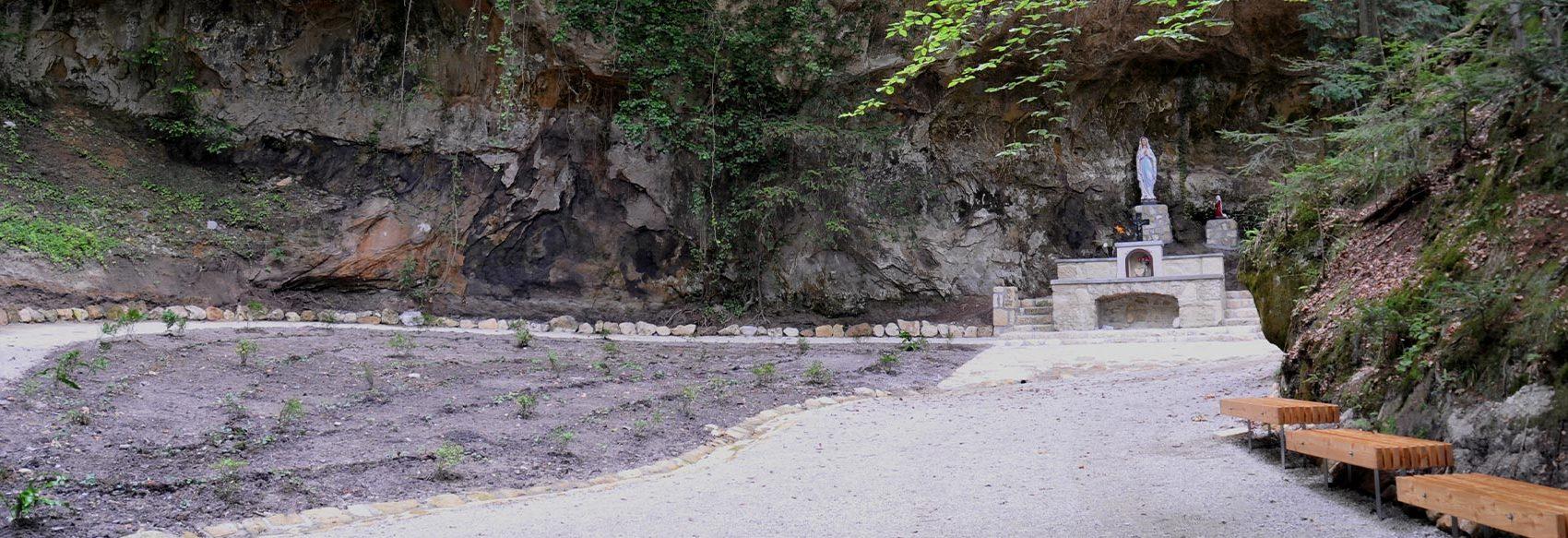
Lurška Cave
The Lurška Cave is a large sinkhole in sandstone of Miocene age (about 20 million years old), up to 38m wide and 17m high, now heavily overgrown with moss and ivy. Water seeps through in several places and collects at the bottom to form small streams. In some places, water seepage through the moss has already led to the formation of tuff.
People attribute the miraculous power of the water that springs here to heal the eyes. A stone altar with a cross and a statue of the Virgin Mary was built under a sandstone overhanging rock in the middle of the forest. Pilgrims making the pilgrimage to Our Lady of Mercy in Zagorje also pass through the Lurška Cave. The Lurška Cave is open to visitors. It is the venue for various cultural and social events. The Lurška cave is a point along the Mary’s pilgrimage route connecting places in Slovenia, Croatia and Austria.
Access to the Lurška Cave is signposted from the village of Zagorje.


Map
Explore other natural attractions in Kozjansko Regional Park:
Gruska, which lies just off the main Kozje–Buče road, is a distinctly noticeable pocket valley, starting with a 30-metre-high overhanging wall. In the wall, there is the source of the Gruska stream, which turns into a beautiful waterfall during heavy rains.
At Gradišče above Podsreda (3.3km from Podsreda) is the Kozjansko Park’s tall-stemmed orchard, where more than 120 varieties of apple and more than 60 varieties of pear are planted.
The Vetrnik area is dotted with beautiful, colourful dry grasslands, which are remarkable for their wealth of flora and fauna.
Between Podsreda and Bistrica ob Sotli, the Bistrica River has created a beautiful gorge, which is considered to be the most picturesque and well-preserved river gorge in eastern Slovenia.
The Lurška Cave is a large sinkhole in sandstone of Miocene age (about 20 million years old), up to 38m wide and 17m high, now heavily overgrown with moss and ivy.
The spring is located in the lithothamnion limestone, in the solitary karst of the Kozjansko Park. Karst springs are characterised by high fluctuations in flow and occasional turbidity at high water.
These are caves, dug into quartz sand that was brought to the Bizeljsko area millions of years ago by the Pannonian Sea. The sand holes belong to the indigenous natural, historical, ethnological, and cultural heritage of the area and are an attraction along the Bizeljsko–Sremič wine tourist road.
In the steep wooded hillside above the left bank of the Bistrica River in Pilštanj, a picturesque rock called Ajdovska žena was formed in dolomite. It is 12m high (7m on the sloping side) and 2m wide.
One of the most beautifully coloured birds living in Slovenia, the European bee-eater (Merops apiaster), nests in an abandoned quartz sand mine in Župjek near Bizeljsko. It nests in colonies and Župjek has the oldest continuous colony of European bee-eaters, with around 30 nesting pairs.