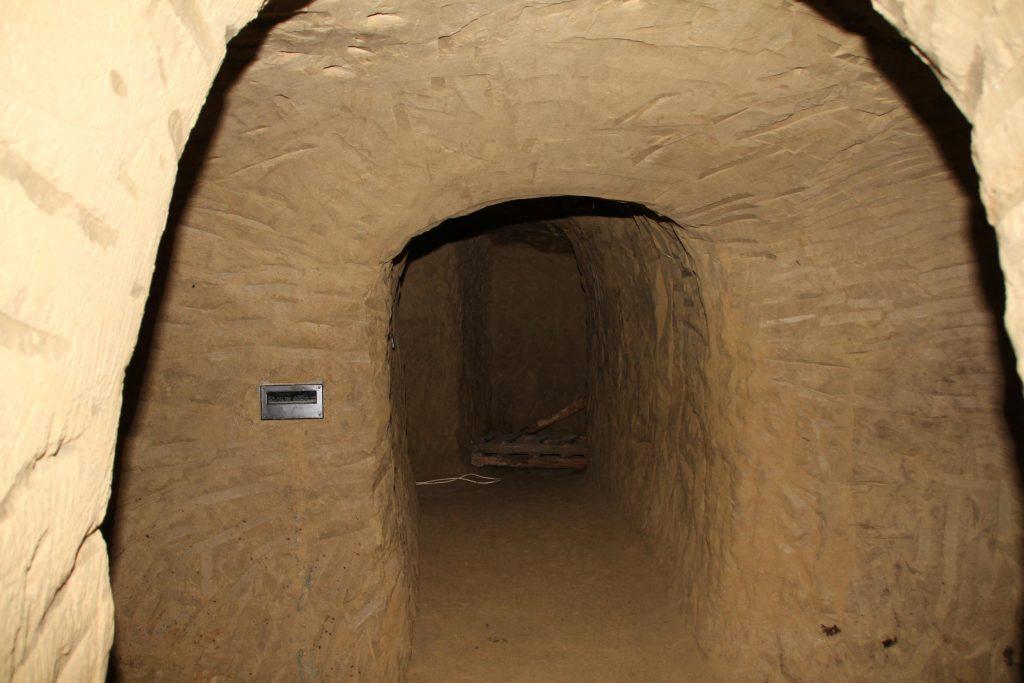
These are caves, dug into quartz sand that was brought to the Bizeljsko area millions of years ago by the Pannonian Sea. The sand holes belong to the indigenous natural, historical, ethnological, and cultural heritage of the area and are an attraction along the Bizeljsko–Sremič wine tourist road.
The locals dug holes of various sizes in the quartz sand with picks and spades. No building materials were used, except for the entrance, which protected the hole from the outside weather and had to be specially fortified. They are named after the turnip (repa) that people used to store in them, along with other produce. Because of constant humidity (95%) and temperature (8°C), they have historically been the best place to store field produce.
Today, they are still used in some places for storing crops, but mostly for ageing and storing wine. The high humidity in them is not suitable for storing wine in wooden barrels, so wine growers store wine in stainless steel containers and bottles. Visitors are offered a tasting of typical wines from the Bizeljsko – Sremič wine-growing region.
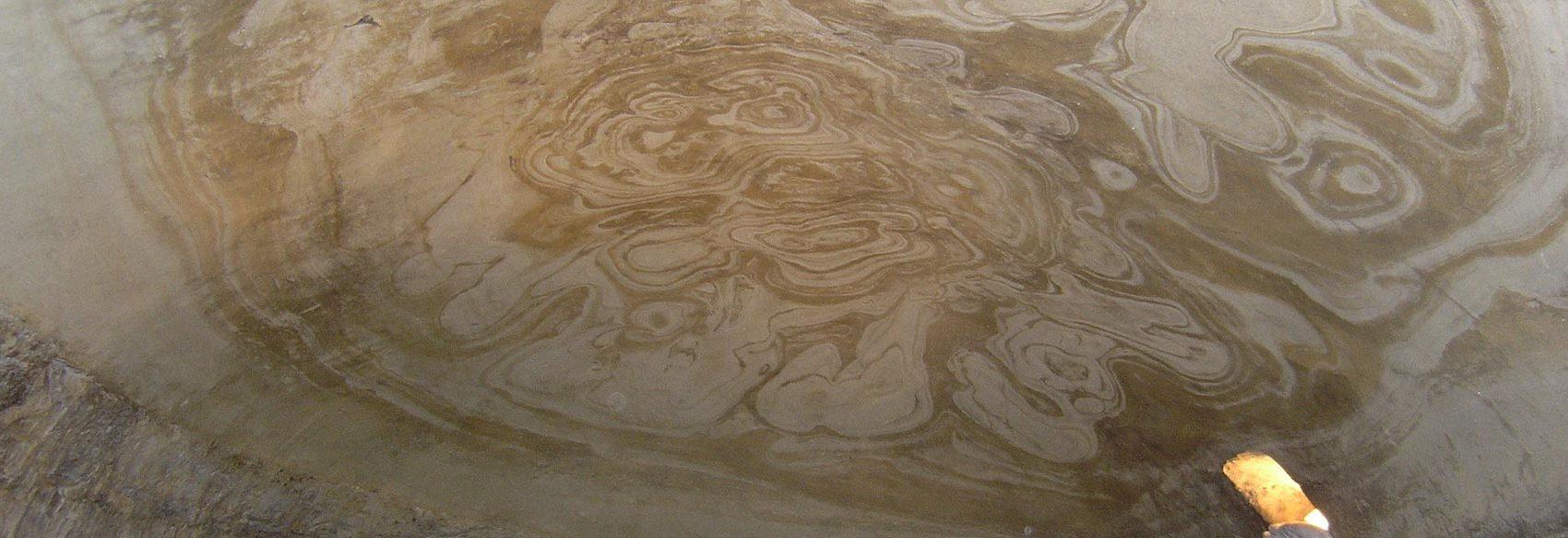
In the villages of Brezovica, Bizeljsko, Pišece and Globoko, you can even visit more than 200-year-old repnice, which provide a truly unique experience. Some of them have unusually interesting ornaments on the ceiling or walls.
Six of them are currently open for viewing: Repnica Najger, Repnica pri Balonu, Repnica Graben, Repnice Pudvoi, Repnica Kelher, and Repnica pri Kovačičevih.
More information: https://www.discoverbrezice.com/repnice
Gruska, which lies just off the main Kozje–Buče road, is a distinctly noticeable pocket valley, starting with a 30-metre-high overhanging wall. In the wall, there is the source of the Gruska stream, which turns into a beautiful waterfall during heavy rains.
At Gradišče above Podsreda (3.3km from Podsreda) is the Kozjansko Park’s tall-stemmed orchard, where more than 120 varieties of apple and more than 60 varieties of pear are planted.
The Vetrnik area is dotted with beautiful, colourful dry grasslands, which are remarkable for their wealth of flora and fauna.
Between Podsreda and Bistrica ob Sotli, the Bistrica River has created a beautiful gorge, which is considered to be the most picturesque and well-preserved river gorge in eastern Slovenia.
The Lurška Cave is a large sinkhole in sandstone of Miocene age (about 20 million years old), up to 38m wide and 17m high, now heavily overgrown with moss and ivy.
The spring is located in the lithothamnion limestone, in the solitary karst of the Kozjansko Park. Karst springs are characterised by high fluctuations in flow and occasional turbidity at high water.
These are caves, dug into quartz sand that was brought to the Bizeljsko area millions of years ago by the Pannonian Sea. The sand holes belong to the indigenous natural, historical, ethnological, and cultural heritage of the area and are an attraction along the Bizeljsko–Sremič wine tourist road.
In the steep wooded hillside above the left bank of the Bistrica River in Pilštanj, a picturesque rock called Ajdovska žena was formed in dolomite. It is 12m high (7m on the sloping side) and 2m wide.
One of the most beautifully coloured birds living in Slovenia, the European bee-eater (Merops apiaster), nests in an abandoned quartz sand mine in Župjek near Bizeljsko. It nests in colonies and Župjek has the oldest continuous colony of European bee-eaters, with around 30 nesting pairs.
KOZJANSKO REGIONAL PARK Accessibility Statement
We firmly believe that the internet should be available and accessible to anyone, and are committed to providing a website that is accessible to the widest possible audience, regardless of circumstance and ability.
To fulfill this, we aim to adhere as strictly as possible to the World Wide Web Consortium’s (W3C) Web Content Accessibility Guidelines 2.1 (WCAG 2.1) at the AA level. These guidelines explain how to make web content accessible to people with a wide array of disabilities. Complying with those guidelines helps us ensure that the website is accessible to all people: blind people, people with motor impairments, visual impairment, cognitive disabilities, and more.
This website utilizes various technologies that are meant to make it as accessible as possible at all times. We utilize an accessibility interface that allows persons with specific disabilities to adjust the website’s UI (user interface) and design it to their personal needs.
Additionally, the website utilizes an AI-based application that runs in the background and optimizes its accessibility level constantly. This application remediates the website’s HTML, adapts Its functionality and behavior for screen-readers used by the blind users, and for keyboard functions used by individuals with motor impairments.
If you’ve found a malfunction or have ideas for improvement, we’ll be happy to hear from you. You can reach out to the website’s operators by using the following email
Our website implements the ARIA attributes (Accessible Rich Internet Applications) technique, alongside various different behavioral changes, to ensure blind users visiting with screen-readers are able to read, comprehend, and enjoy the website’s functions. As soon as a user with a screen-reader enters your site, they immediately receive a prompt to enter the Screen-Reader Profile so they can browse and operate your site effectively. Here’s how our website covers some of the most important screen-reader requirements, alongside console screenshots of code examples:
Screen-reader optimization: we run a background process that learns the website’s components from top to bottom, to ensure ongoing compliance even when updating the website. In this process, we provide screen-readers with meaningful data using the ARIA set of attributes. For example, we provide accurate form labels; descriptions for actionable icons (social media icons, search icons, cart icons, etc.); validation guidance for form inputs; element roles such as buttons, menus, modal dialogues (popups), and others. Additionally, the background process scans all the website’s images and provides an accurate and meaningful image-object-recognition-based description as an ALT (alternate text) tag for images that are not described. It will also extract texts that are embedded within the image, using an OCR (optical character recognition) technology. To turn on screen-reader adjustments at any time, users need only to press the Alt+1 keyboard combination. Screen-reader users also get automatic announcements to turn the Screen-reader mode on as soon as they enter the website.
These adjustments are compatible with all popular screen readers, including JAWS and NVDA.
Keyboard navigation optimization: The background process also adjusts the website’s HTML, and adds various behaviors using JavaScript code to make the website operable by the keyboard. This includes the ability to navigate the website using the Tab and Shift+Tab keys, operate dropdowns with the arrow keys, close them with Esc, trigger buttons and links using the Enter key, navigate between radio and checkbox elements using the arrow keys, and fill them in with the Spacebar or Enter key.Additionally, keyboard users will find quick-navigation and content-skip menus, available at any time by clicking Alt+1, or as the first elements of the site while navigating with the keyboard. The background process also handles triggered popups by moving the keyboard focus towards them as soon as they appear, and not allow the focus drift outside it.
Users can also use shortcuts such as “M” (menus), “H” (headings), “F” (forms), “B” (buttons), and “G” (graphics) to jump to specific elements.
We aim to support the widest array of browsers and assistive technologies as possible, so our users can choose the best fitting tools for them, with as few limitations as possible. Therefore, we have worked very hard to be able to support all major systems that comprise over 95% of the user market share including Google Chrome, Mozilla Firefox, Apple Safari, Opera and Microsoft Edge, JAWS and NVDA (screen readers).
Despite our very best efforts to allow anybody to adjust the website to their needs. There may still be pages or sections that are not fully accessible, are in the process of becoming accessible, or are lacking an adequate technological solution to make them accessible. Still, we are continually improving our accessibility, adding, updating and improving its options and features, and developing and adopting new technologies. All this is meant to reach the optimal level of accessibility, following technological advancements. For any assistance, please reach out to