

CASTLES
In the Kozjansko and Obsotelje regions, castles were constructed from the 10th century on in naturally secure locations with the purpose of strengthening the defense along the Sotla, which is the border river. Some castles have completely disappeared in the centuries that followed and only mighty remains remind us of others, such as Kunšperk and Kozje castles. Through the centuries, the Pišece, Bizeljsko, Olimje, and Podsreda castles have been preserved. The latter two have received a new purpose later on, all of them however remain in the memory of the locals, as well as go on living in legends and stories.
Podsreda Castle
Podsreda Castle is located in the heart of Kozjansko Park, above the eponymous Podsreda Market Town, at an altitude of 475m above sea level.
Hörberg or Herberch, as the castle was once called, is one of the most important examples of Romanesque architecture in Slovenia as its medieval core has remained virtually unchanged over the centuries.
The owner of the land on which Podsreda Castle stands today was our first saint, St. Emma. The origins of “the most castle-like of Slovenian castles” date back to the 12th century. Over the centuries, the castle has changed hands: the Bishops of Krško, the Counts of Celje, the Tattenbach family, the Lazarini family, and the last owners of the castle – the Windischgrätz family. Today, the castle is owned by the Kozje Municipality and managed by Kozjanski Park since 1983.
Podsreda Castle is one of the few cultural monuments of the Romanesque era in Slovenia, which has been renovated from its past state of decay over the last forty years to become an important carrier of the cultural, promotional, educational, social, and tourist offerings of Kozjansko Park, living a full and rich life with its varied programme.
Visitors can enjoy a tour with audio guides or various guided tours (tourist, expert, or individual).
Families can try their hand at the family adventure Treasure Hunt at Podsreda Castle, and there is a Castle Café and a shop selling local products with the Kozjansko Park Visitor Centre.
You can also stay overnight in the four-star accommodation – Podsreda Castle rooms and apartments – and start your morning with a castle breakfast of local delicacies.
You can also reach the castle on foot from the medieval Podsreda town via the 2.5km long, interactive Podsreda Castle Trail.

Pišece Castle
The huge area of the Posavje region, of which Pišece is also a part, used to be a part of the Posavje estates owned by the archbishop of Salzburg. This area was constantly threatened by the Hungarians, therefore the archbishop of Salzburg had several castles built, among them also the Pišece castle. The castle itself is mentioned in sources as early as in 1268, when the ministerials of Salzburg, the knights of Pišece, are stated as the owners, who managed the castle until 1353. After there we no more knights, the castle was managed by the archbishop’s administrators for more than 200 years. In 1595, the Pišece estate was bought by Innocenc Moscon as a legal and inheritable property. The Moscon family owned the estate until 1938, when the entire property was auctioned and the castle was nationalised, whereas the forests were sold to private owners.
The mighty Romanesque tower and the castle chapel have been preserved from the earliest times of the castle. All the other parts of the castle were built later, i.e. from the Renaissance, and later also rebuilt. In 1867, the castle got today’s neo-Romanesque appearance.
The Moscon family, who owned the castle for almost 350 years, was also very important and influential locally, its influence also reaching far beyond the locality’s borders. Their lives did not only go on behind the castle’s walls. The surroundings were very beautifully landscaped with a garden and a pond where exotic trees still grow to this day – sequoias, sycamore trees, ginkgo, southern catalpa, honey locust, etc.
Pišece Castle has undergone a major renovation in recent years, led by the Ministry of Culture.
Information: http://www.pisece.si/

Bizeljsko Castle
Bizeljsko, which used to belong to the hereditary estate of Hemma of Gurk (Friesach-Zeltschach), was passed into the ownership of the newly established diocese of Gurk after her death.
As an estate of the diocese of Gurk, Bizeljsko is mentioned as early as in 1251. At that time, there was already a smaller manor in the same spot. In the gift deed for the manor from 1278 knight Eberhard von Visel is mentioned as a witness. Later on, in the 15th century, the castle was rebuilt. It was owned by the diocese of Gurk and managed by the knights of Bizeljsko. In 1532, the bishop of Gurk let the estate to Hans Tattenbach, whose heirs received the estate as inheritable property in 1608. Afterwards, several families owned the castle. In 1858, the estate was bought by the Windischgrätz family. Between both world wars, Hugo a S. Croce was the owner of the castle, whereas the owners during World War II were baroness Christina and her husband Nikolaj von Maasburg. After World War II, ownership of the castle transferred to the state.
The features of the castle are typical for the Renaissance period as it underwent numerous modifications throughout the centuries with each period adding something new, however its fundamental characteristics have remained in-line with its oldest depictions.
The most intact is the central building with four wings that surround the inner courtyard and is fundamentally medieval. In the Renaissance, this core was reinforced with two defense towers. In 1623, the St. Jerome chapel was built next to the entrance into the castle.
Information: http://www.bizeljsko.si/zanimivosti/grad-bizeljsko.html

Kunšperk Castle
Kunšperk lies on land inherited by Hemma of Gurk (Friesach-Zeltschach). In 1042, she passed it to the women’s Benedictine monastery in Krka, Carinthia, whereas in 1071 its ownership passed to the diocese of Gurk.
The original castle of Kunšperk was already present in the area at that time, having been built for defense reasons. Its position directly above the River Sotla commanded the Croatian Zagorje region as the opposite pair to the Croatian castle Cesargrad. The sources mention the castle as late as in the 12th century, when bishop Henry of Gurk had it torn down because of a dispute with Otto von Hernek with regard to the appropriation of the Gurk estates. After Henry and Otto resolved their dispute, the castle was rebuilt. In the following years, the knights of Kunšperk are mentioned as the owners of the castle. The power of the knights of Kunšperk faded after 1300 and their estate started crumbling. Afterwards, the Counts of Celje are mentioned as the owners of the castle and the Habsburg dynasty after their demise. In the 16th century, the Tattenbach family owned both castles, Bizeljsko and Kunšperk. The seat of the Kunšperk estate was transferred to Bizeljsko and the estate was thus managed from there. The Windischgrätz family is stated as the last owners.
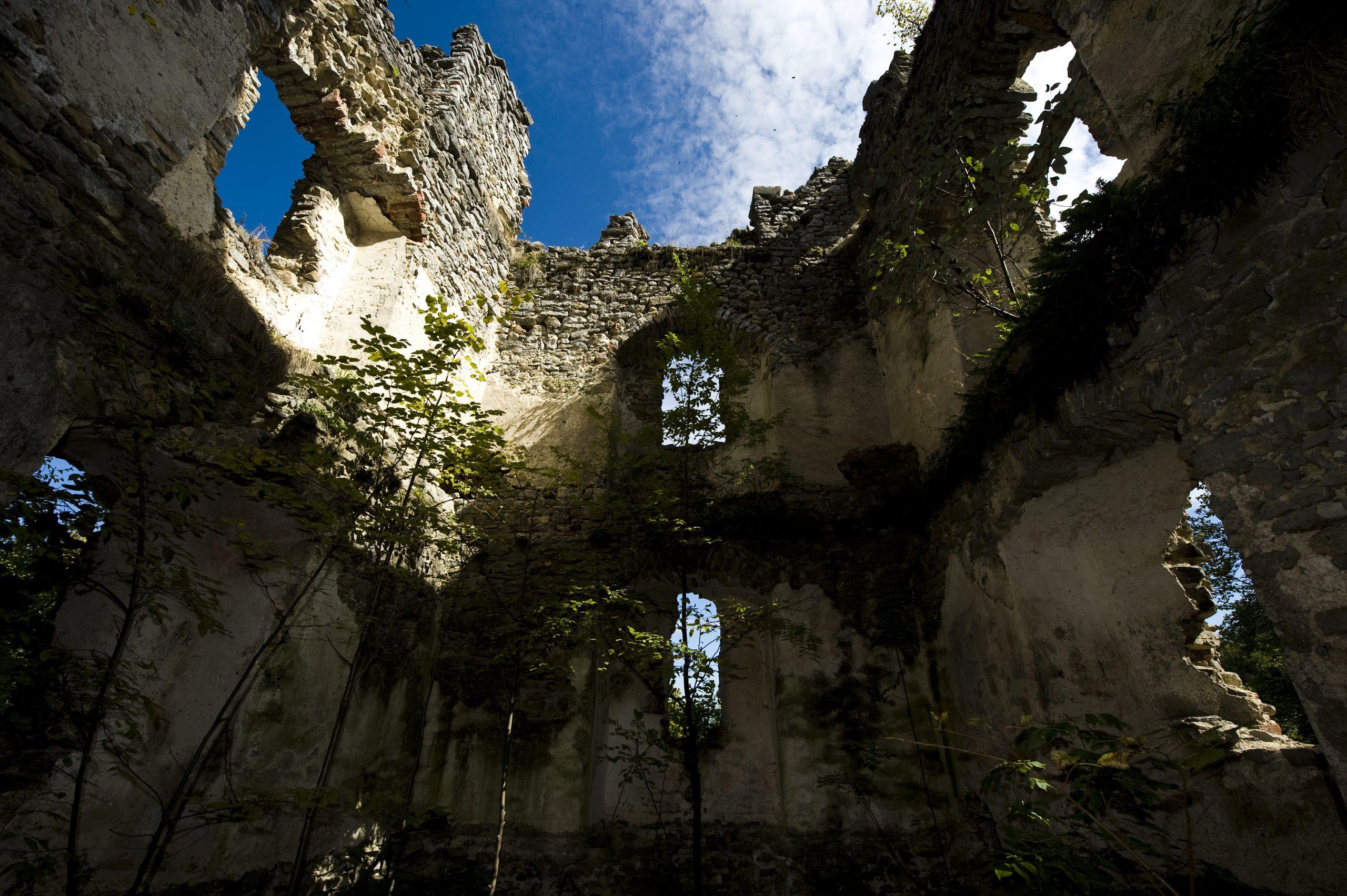
Today, the Kunšperk castle is in ruins. From the once numerous buildings only the mighty Romanesque bergfried – defense tower, part of the walls and the castle chapel have been preserved.
Podčetrtek Castle
It belongs to the oldest castles in Kozjansko, which is also evident from its original name – Landsberg, meaning the provincial castle; i.e. the castle in control over the province since it is located at a spot with commanding views over the Obsotelje region and the border with the former Hungarian kingdom. It was probably built sometime after 1100. It is located in the area of former Hemma’s estates. It was constructed by the bishops of Gurk and managed by the knights of Podčetrtek. In 1527, the administrator of the castle became Hans Tattenbach. However, his successors received the castle from the diocese of Gurk into permanent inheritable possession as late as in 1612.
In 1671, the head of the Tattenbach family, Hans Erasmus von Tattenbach, was decapitated in Graz for having been accused of being part of the Zrinski-Frankopan conspiracy against the Habsburgs.
The entire property of the family was confiscated by the state, who sold the castle in 1682 to duke Ignatius Maria Attems. The latter family owned the castle until the end of World War II. After the war, the castle served several purposes. Once opulent furnishings were displaced, the castle also housed residential flats recently.
It is now owned by the Municipality of Podčetrtek, which has already partially restored it.

Castles of Posavje
Castles shape our cultural landscape and our identity. Especially in Slovenia, where we boast many well-preserved and restored castles, and castles that constantly remind us that more needs to be done.
The castles of Posavje have been connected since 2014. They include the managers of six castles in Posavje, who have joined the informal association, namely: Božidar Jakac Gallery Kostanjevica na Krki, which manages the former monastery in Kostanjevica na Krki, Kozjanski Park Podsreda, which manages Podsreda Castle, Krško Cultural Centre, Rajhenburg Castle unit, which manages Rajhenburg Castle, KŠTM Sevnica, which manages Sevnica Castle, Posavje Museum Brežice, which manages Brežice Castle, and Terme Čatež, which owns Mokrice Castle.
The years 2020 and 2021 were also special years for Posavje Castles. At a challenging time for all, our association was awarded the title Jakob 2020 and the title of Ambassador of Innovation in Tourism for castles and manors. In 2021, the E-castles of Posavje project was successfully completed and made available to the public, where you can get to know seven castles in one “castle room” at Terme Čatež. The digitisation project was led by the Posavje Regional Development Agency with the support of Posavje municipalities. The castles of Brežice, Kostanjevica na Krki, Mokrice, Podsreda, Rajhenburg, and Sevnica are joined by the still interesting ruins of Kunšperk and Svibno Castles, which have been brought to virtual life by the project. The brochure – guide provides the user with basic information, but above all invites to explore and enjoy.
