KOZJANSKO REGIONAL PARK

ORCHIDS

Orchids are the most abundant plant family. According to the pictorial guide “Orhideje Slovenije” (Orchids of Slovenia) (Branko Dolinar, 2015), 79 species and subspecies occur in Slovenia. Depending on the type of environment they grow in, orchids are classified as grassland or forest plants. Some are only widespread in the high mountains. Our data shows that in the Kozjansko region, forty species and subspecies of orchids have been found so far. They are mostly found in sunny dry hill meadows and on southern forest slopes.

In the last decades, especially the grassland species have been heavily exposed to an intensified exploitation of grasslands, which is why the populations of these species is shrinking. Increasingly popular photography can also completely destroy small populations. All orchid species in Slovenia are protected. The habitat of the dry, orchid-rich meadows is further protected by the Habitats Directive, which includes the meadows at Vetrnik, Oslica and Bohor in the Natura 2000 ecological network.

The greatest number of blossoming orchids can be seen from the end of April to the end of June. In forests, the flowering season lasts throughout July (genus of helleborines).


GREEN-WINGED ORCHID (Anacamptis morio)

One of the most commonly observed species, it flowers in dry, unfertilised and regularly mown meadows in April and May. With its abundance of purple flowers, it gives spring meadows a distinctive look.

ELDER-FLOWERED ORCHID (Dactylorhiza sambucina)

It flowers in two colour variations (yellow and purple) on unfertilised dry meadows at the end of April. It is named after its scent, which is reminiscent of elderflower.

BEZGOVA PRSTASTA KUKAVICA

BEE ORCHID (Ophrys apifera)

Flowering in June, this species thrives on dry, unfertilised meadows and forest edges. Usually with only a few specimens. The flower’s shape, colour pattern (in the UV spectrum detected by bees), and scent mimic a female bee attracting a male. When nearby flying drones detect its scent, they follow it all the way to the flower. They try to mate, but in doing so they only “pick up” pollen, which they then pass on to the next false female.

čebeljeliko mačje uho

FRAGRANT ORCHID (Gymnadenia conopsea)

This slender and stately orchid species blooms on dry meadows with a carbonate substrate from the end of May until July. The long, light pink cylindrical inflorescence has a delicate scent.

navadni kukovicnik

ADRIATIC LIZARD ORCHID (Himantoglossum adriaticum)

This warm-loving, tall-growing orchid thrives on the edges of meadows and can tolerate partial shade. The first leaves appear in autumn. The tiny flowers with an extremely long labellum give off the scent of goats or urine. It helps them attract pollinators – many species of solitary bees and bumblebees. It is also a qualifying species in Natura 2000 sites.

jadranska smrdljiva

BIRD’S-NEST ORCHID (Neottia nidus-avis)

A common forest species, lacking chlorophyll (entirely in shades of brown). It flowers in May, and the dry stems can be seen until the following spring. It is similar to broomrapes, which are not orchids. It is called the bird’s nest orchid because of its distinctive bird’s nest-shaped roots.

rjava gnezdovnica

BROAD-LEAVED HELLEBORINE (Epipactis helleborine)

The largest of the mainly forest-growing helleborines, it can grow over half a metre tall and has dozens of flowers in July. Despite its genus name, it thrives in dry soils. We have a number of very similar species and subspecies growing in our area.

širokolistna močvirnica

AUTUMN LADY’S-TRESSES (Spiranthes spiralis)

It is the last flowering species among orchids, and only flowers in September. Up to 30 tiny white flowers are spirally arranged around the stem at the top of the 20cm tall stem. It thrives in barren, late-mown meadows.

zavita skrbica

SPECIAL BOTANICAL FEATURES

Due to the various geographical characteristics, species typical of alpine, Pannonian and sub-Mediterranean areas can be found in the Kozjansko region in addition to the common continental species. Many of those species reach the extreme limits of their habitat. Below, some of the species are described in more detail.

TRUE ATRORUBENS (Helleborus atrorubens)

This is a hellebore species that can only be found in the area comprising Kozjansko, Lower Carniola, Bela krajina, and part of Croatia (up to Karlovac). Its deep purple (scarlet) blossoms can mostly be seen on the edges of the forest and often also in the forests or pastures. If the species grows where there are green-blossomed fragrant hellebores (H. odorus), cross-fertilization may occur. Like all hellebores, this species is also protected (transplanting and collecting seeds is forbidden).

temnoškrlatni teloh

BLAGAJ DAPHNE (Daphne blagayana)

Most of the locals refer to this species as the royal flower. Along with the edelweiss, it was the first plant to be protected on Slovenian soil in 1898. It was discovered in 1837 on the Grmada hill by Polhov Gradec and was named after Count Blagaj. This low evergreen shrub shows all its beauty in April when it blossoms. It thrives in steep and shady beech forests, scattered throughout Kozjansko.

blagajev volčin

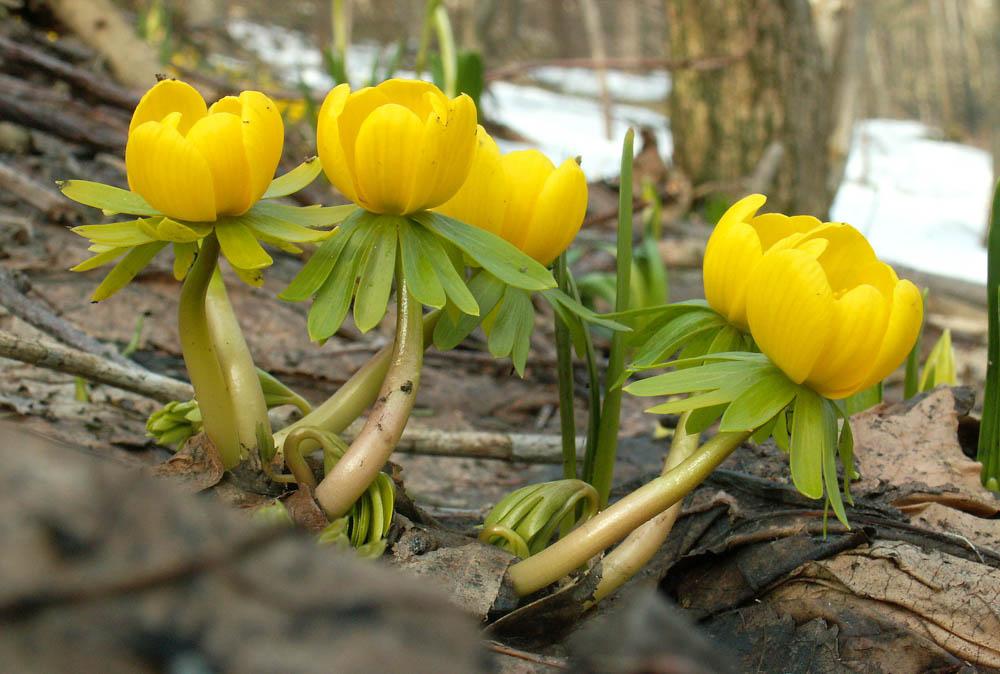
WINTER ACONITE (Erantis hyemalis)

It is one of the first plant species to flower when the snow melts. It can even withstand snow once it has formed its blossoms. It grows on the forest floor and also on forest edges on Bohor hill and in Podsreda. Usually, the plant completely covers the ground, thus colouring the ground completely golden yellow. Since 2004 it has been a protected species. Seeds can be obtained from nurseries, as it thrives in gardens and parks.

navadna jarica

NARROW LEAVED SANDWORT (Moehringia bavarica)

Like all sandworts, the narrow leaved sandwort also grows in rocky walls. It forms mats around the crack, in which its permanent root is positioned. In the middle of April, snow-white blossoms develop. It can be found above the Orešje village and on dolomite solitary rocks of the Kopitnik hill. It is mainly endangered due to physical destruction caused by climbing.


bavarska popkoresa

MOUNTAIN COWSLIP (Primula auricula)

As the name itself indicates, this is a mountain species and is one of the symbols of alpine flora. In the Kozjansko hills, it is found on the colder dolomite rock walls of the northern slopes, where it has survived since the Ice Ages (glacial relict). The edges of its tough, leathery leaves are coloured white due to limestone secreted by the plant. It normally blossoms in April, but this depends on the duration of wintery conditions. As it is protected, it is not allowed to be picked or transplanted into home rock gardens.

avrikelj

FRINGED PINK (Dianthus monspessulanus)

Of all carnations, growing in Kozjansko, it features the most magnificent blossoms. At first sight it appears as if its floral leaves had been ripped by a strong wind. On dry, grassy and sun-exposed areas of Vetrnik, Oslica, and Bohor hills, as well as in rocky walls of the Zagaj gorge, the plants blossom in July. The blossoms can be either pinky or completely white. With the exception of sweet William, all the other carnation species are protected in Slovenia.

montpellierski nageljček

BUTCHER’S-BROOM (Ruscus aculeatus)

A common species of shrubby vegetation (maquis) in the Mediterranean, it thrives surprisingly well in beech forests on the northern slope of Orlica. This evergreen perennial grows up to 80cm tall and has a bushy form. The apparent leaves are leathery and sharply pointed, up to 3.5cm long. Tiny green and white blossoms grow from the very centre of these leaves. A bright red berry develops from the blossoms. Much more common is the horse tongue lily, which has shorter, lying shoots. Over-harvesting for winter bouquets has made both species rare and consequently protected.

bodeča lobodika

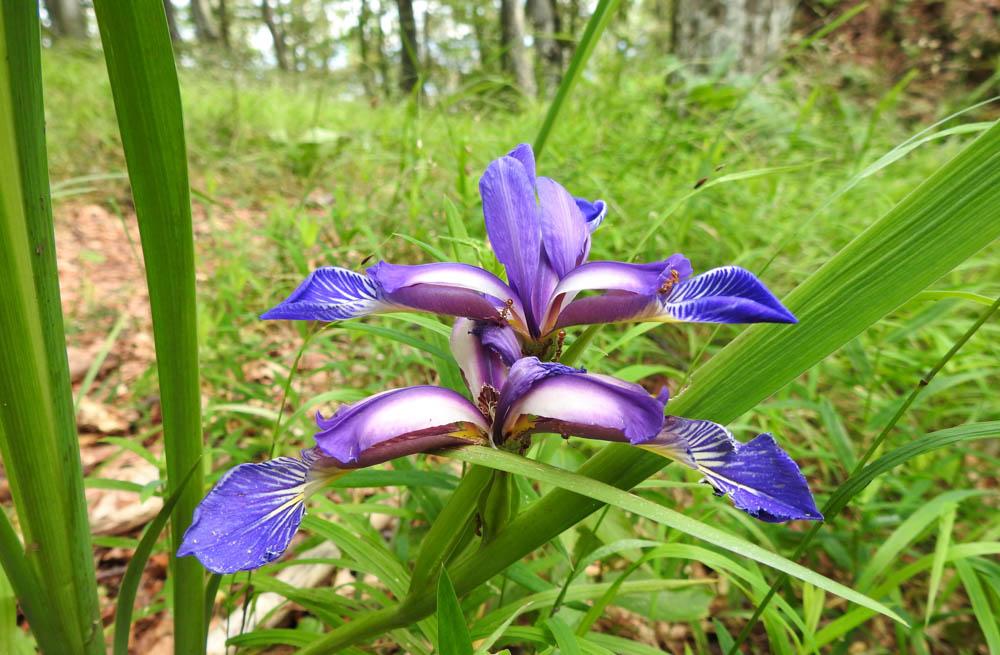
GRASS-LEAVED IRIS (Iris graminea)

This is the smallest of all “wild” irises. It grows on sunny ground with little soil, usually on forest edges. Flowers, which appear in May, can hardly be seen due to its long, sabre-shaped leaves, hidden right above ground. In Slovenia, all iris species are protected. The sites of the plum iris remain unthreatened, but the Siberian iris sites are quite different. It thrives in marshy meadows, which have completely disappeared in recent years (drying out). And the yellow flag disappeared with them.

travnolistna perunika

EUROPEAN BLADDERNUT (Staphylea pinnata)

A shrub species that thrives in the shade of tree canopies. In April, pendulous inflorescences develop, attracting many pollinators. The flowers develop into blister-shaped catkins. If you shake them, it makes a sound like a rattle.

navadni kloček

HUNGARIAN CLOVER (Trifolium pannonicum)

A stately species of clover (grows up to 40cm tall) with pale yellow inflorescences, it thrives in dry, extensively cultivated meadows and woodland edges. It has a rare species status on the red list. Possibility of replacement by the more common sulphur clover.

panonska detelja

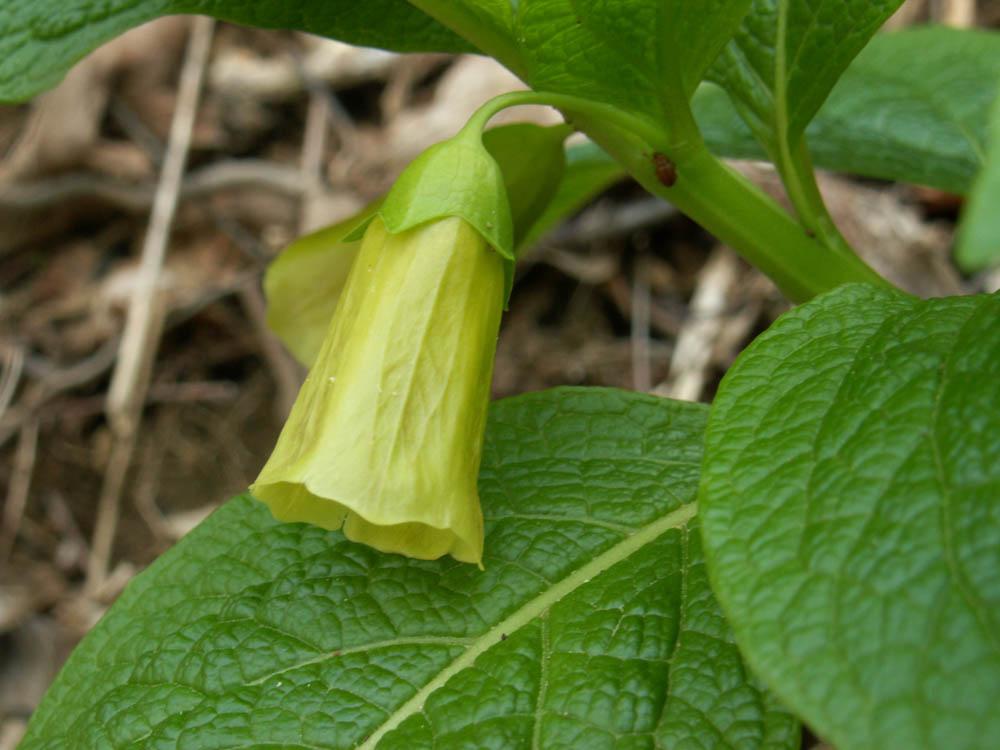
YELLOW FLOWERED EUROPEAN SCOPOLIA (Scopolia carniolica f. hladnikiana)

The European scopolia is a relatively common spring-flowering species of moist and shady forest ravines. It is, however, rare to find plants with bright yellow flowers in clusters of scopolia. In honour of the finder, Franc Hladnik (1819, head of the Botanical Garden in Ljubljana), this species is named after him.

hladnikova bunika

COMMON WIND FLOWER (Pulsatilla nigricans)

With its drooping purple flowers, it resembles the greater pasque flower. This is no coincidence, as the species are of the same genus. The stem, developing leaves and flowers are densely hairy, an adaptation to flowering during frequent frosts, wind and water shortages. Due to the decline of suitable extensively cultivated grasslands, it is listed as a vulnerable species on the red list.

Navadni kosmatinec

ALPINE BARRENWORT (Epimedium alpinum)

A forest herb whose three trifoliate leaves are green all year round, and small yellow-pink flowers develop in early spring. Typical of beech forests. The similarity of the shape and colour of the flower to the headdress of bishops gives it the popular name “bishop’s cap” in Slovenia and Croatia.

BIRDS IN MEADOW ORCHARDS

Thanks to old trees, the absence of spraying and non-intensive use of land, meadow orchards are an important habitat for many bird species. Mature and old trees provide nesting holes and extensive use allows the presence of many insects, an important food source for many bird species.


EURASIAN WRYNECK (Jynx torquilla)

vijeglavka

It is the smallest woodpecker species in Slovenia and the only migratory one. It requires suitable trees with holes or anthills for its successful nesting. The bird raises its offspring in existing cavities (or nesting boxes) that are only present in older and thicker fruit trees. The offspring mainly feed on ants. The Eurasian wryneck is one of the few species known for singing abilities in both the males and females.

COMMON REDSTART (Phoenicurus phoenicurus)

In April, one of the most beautiful birds in Slovenia returns from warm regions of Africa. It nests in tree cavities, as well as in suitable nesting boxes. The common redstart has become highly endangered due to destruction of extensive orchards with tall trees, use of phytopharmaceutical agents on fruit trees (poisoning of insects that it feeds on), and the degradation of the African environment where they spend the winter. In recent decades, the common redstart has become locally extinct in several parts of Slovenia.

EURASIAN SCOPS OWL (Otus scops)

veliki skovik

This owl species (commonly known as “small owl”) prefers a moderate climate, which is why the majority of European population lives in the Mediterranean. It is a migrant, returning to the countryside in May – to meadow orchards and gardens, avoiding closed forests. It builds its nest in tree cavities, suitable holes in walls, as well as in nesting boxes. It feeds on larger insects, such as grasshoppers, beetles, moths, earthworms, as well as small vertebrate animal, such as mice, frogs, small birds and lizards. It is threatened by a lack of suitable nesting sites and environmental degradation.

EUROPEAN GOLDFINCH (Carduelis carduelis)

This is a non-migratory bird, which lives in orchards and open areas with individual trees and bushes, parks and gardens. It builds its nests on the ends of branches of deciduous trees, at least 2 metres above the ground. It feeds on insects, thistle seeds, grass and crop plants, as well as tiny tree seeds and buds. In the winter, it eats sunflower and millet seeds from birdfeeders.


RED-BACKED SHRIKE (Lanius collurio)

rjavi srakoper
rjavi srakoper,samec

Like other representatives of shrikes, the red-backed shrike is a carnivorous bird, which is also shown by its strong beak with a curved end. It mainly feeds on larger insects, as well as vertebrate animals (smaller birds, reptiles, and rodents). This bird inhabits cultural landscapes – in areas where meadows are interrupted by cultivated land and low bushes. It builds its nest in thorny bushes (such as hawthorn or dog rose), using twigs. It has been reported that it sticks its prey on thorns. However, such behaviour is quite rare. Populations of this species are shrinking in most parts of Europe, which is why efforts are being made to protect it in Natura 2000 areas. It is a migratory bird, moving to Africa in autumn and returning usually in May when it has enough food.

EUROPEAN GREEN WOODPECKER (Picus viridis)

A year-round species, it moves around in winter looking for suitable conditions. It can be confused in appearance with the rarer grey-headed (grey-faced) woodpecker. It is often seen on grassy ground, where it searches for anthills (feeding on ants and their larvae). It builds its own nesting hole in a suitably thick trunk.


EURASIAN HOOPOE (Upupa epops)

One of the most unusual bird species in our country, with a distinctive feather bonnet on its head. In flight, it resembles a butterfly. It searches for food on the ground with its long pointed beak (large insects, larvae, earthworms). It inhabits dry, open landscapes. It nests in holes in walls, buildings, or in the trunks of old trees. It sings with a repeated “up-up, up-up”. In many languages, it is named after the sound it makes (English “Hoopoe”, Polish “dudek”, Croatian “pupavac”), but in Slovenia, it is named after the smelly secretion that the young use to defend themselves from predators.

FIELDFARE (Turdus pillaris)

A relative of the blackbird, which is mainly found in Slovenia only in winter. During this time, it feeds on the fruits of hawthorn, rowan, blackthorn, and apple trees. It is sociable, which is why it is seen in loud flocks. In the past, it used to be hunted for this reason. Srečko Kosovel wrote about this in his poem Brinovka (Fieldfare) (“In the quiet autumn time, the fieldfare comes to Karst…”).

YELLOWHAMMER (Emberiza citrinella)

A type of open cultural landscape with hedges, individual trees. It searches for food on the ground and nests there as well. The intensification of agriculture has made it increasingly rare. Part of its song was used by composer Ludwig van Beethoven for the opening of his famous Symphony No. 5.

MISTLE THRUSH (Turdus viscivorus)

A relative of the blackbird, which stays here all year round. In winter, it is often seen on trees with clumps of white mistletoe. Its white fruits are an important part of its diet. The bird itself helps spread the species to other trees.

FOREST BIRDS

Extensive forests are of key importance for the survival of numerous bird species living in forests. Some of these species are present in various kinds of forests (finch), while others require special types of forests (goldcrest). Many forest birds are migratory birds, while species mostly feeding on seeds do not migrate.

FINCH (Fringilla coelebs)

It is one of the most widespread species in the forests of the Kozjansko region. Its round, well-built nest is made of moss, lichen and blades of grass. It builds its nest on forked branches near the trunk. It feeds on various insects, beechnuts, tiny tree seeds and berries. In winter, it likes to visit feeders with seeds, but only looks for seeds on the ground below.

BLUE TIT (Cyanistes caeruleus)

It is a small and lively species of tits that inhabits mainly lowland areas throughout the year. It loves to visit bird feeders. It uses tree hollows, wall holes, and nesting boxes for nesting in forests, parks, and orchards. Of all the songbirds, blue tits have the largest brood. It is not uncommon to find fifteen eggs in a litter.

plavček

TAWNY OWL (Strix aluco)

The most common and well-known representative of the owl family in Slovenia. It is assumed that it has the best night vision of all birds. They do not have moving eyes, but can turn their heads 270°. It comes in two colour variations – light grey (males) and red-brown (females). It inhabits deciduous and mixed forests, forest edges, and also settlements. In feeds at night by hunting mice, voles, shrews, dormice, frogs, smaller songbirds, larger insects, and earthworms. The number of offspring is adjusted to the abundance of prey.

MIDDLE SPOTTED WOODPECKER (Dendrocopos medius)

It primarily lives in oak forests. It nests in old and dying trees – it does not have as strong a beak as other woodpecker species and can only burrow into decaying wood. It feeds on insects and also likes seeds in winter. Due to the lack of nesting space, it has become very rare and is considered an endangered species on a European scale. It is one of the so-called Natura 2000 species (Natura 2000 classification species of the Dobrava – Jovsi SPA area).

srednjidetel

COLLARED FLYCATCHER (Ficedula albicollis)

It is a migratory bird, wintering in Africa. It returns to our forests in the second half of April. It is known for its typical hunting pattern – it flies from its perch high above ground to catch the insect, and then returns to its primary position. The collared flycatcher can be found in light deciduous forests with old trees, as well as in orchards and groves. It is threatened by the lack of suitable natural nesting sites, so we can also help by installing nesting boxes. It is protected within the Natura 2000 network.

belovrati muhar

BLACK WOODPECKER (Dryocopus martius)

Our largest species of woodpecker. The male can be identified by the red colouring on its head. It is the only species that can also hollow out a living tree. It feeds on tree ants found in dry wood. In doing so, it makes large holes in the trunks. Many other species (dormice, bees, hornets, martens) also use its large hollows. It is also a species we conserve through Natura 2000 sites.

SONG THRUSH (Turdus philomelos)

A relative of the blackbird, very similar to the mistle thrush, but it moves away in autumn. It is known for its varied and long-lasting song – hence its name “song thrush”. Its favourite food is snails together with their houses, which they smash on a large rock or stump. These sites can be identified by the many pieces of snail shells.

cikovt

BRAMBLING (Fringilla montifringilla)

A close relative of the finch, which overwinters here. In years of a lot of beechnuts and a lack of snow (which would cover the beechnuts on the ground), millions of bramblings can overwinter in our area. As they return to the same location every night to spend the night, these locations become real tourist attractions.

EURASIAN NUTHATCH (Sitta europaea)

A year-round species found in forests, parks, orchards, and settlements. It likes to visit feeders with seeds in winter. It tirelessly carries them away and stores them in the cracked bark of old trees. It is the only bird species in our country that can climb down a tree trunk (other species can only climb down rearwards). If it finds a suitable nesting burrow with an oversized entrance, it will reduce the size of the burrow by lining it with mud.

brglez

COMMON WOOD PIGEON (Columba palumbus)

Europe’s largest pigeon species was, until recently, strictly a forest species. In recent years, it has also been nesting in settlements with many trees and green areas. It can be identified by white spots on the neck and a white stripe on the wings (noticeable in flight). In autumn, it flies to warmer places.

grivar

EUROPEAN TURTLE DOVE (Streptopelia turtur)

Similar to the Eurasian collared dove, but slightly smaller and more colourful. A forest species that likes to land on bare ground in search of food (seeds, shoots of field weeds). It spends the winter in African savannahs. The large decline in its numbers is linked to modern agriculture and large numbers shot down during migration.

HAWFINCH (Coccothraustes coccothraustes)

The species of finch with the strongest beak. It can also be used to crush cherry pits, maple seeds, or sunflower seeds on feeders. A year-round species in our area. In case of snowy winters or low forest tree regeneration in winter, they arrive in large numbers to settlements (feeding sites). It nests in nests constructed in the tree canopy.

dlesk

EURASIAN BULLFINCH (Pyrrhula pyrrhula)

A relative of the finch and the hawfinch. A year-round forest species in which the male (red-orange chest) and the female (pale sandy chest) are very different in appearance. The main diet consists of seeds and, in winter or spring, buds on tree branches. Therefore, if there is a shortage of seeds, it can cause noticeable damage to fruit trees. It also likes to visit feeders with seeds in times of winter scarcity.

kalin

COAL TIT (Periparus ater)

Our smallest species of tit, named after the white patch on the nape of its otherwise black-coloured (or coal-coloured) head. It spends most of its time in conifers, where it finds small insects and their larvae as well as spiders among the needles. In winter, it also feeds partly on seeds (visits feeders). In the safety of the canopy, his presence is betrayed by a loud “che-pee, che-pee”. It also nests in abandoned mouse holes.

menišček

GOLDCREST (Regulus regulus)

Europe’s smallest singing bird lives mainly in coniferous forests. A year-round bird that also moves around for food in winter. Named after the yellow spot on the top of the head. It builds its nest in the dense shelter of conifer branches. It uses its thin beak to search for small insects and spiders among needles and cones.

rumenoglavi kraljićek

EUROPEAN BEE-EATER – NESTING SITE IN BIZELJSKO

Since the 1980s, a colony of European bee-eaters (Merops apiaster) has been nesting in a sand pit in Župjek near Bizeljsko. The number of nesting bird couples varies, but is usually between 10 and 20, and in some years up to 50.

The bee-eater returns from overwintering at the end of April. It builds its nest in a passage of a vertical sandy wall, almost a meter deep. It used to find suitable rocks in eroded beds of lowland watercourses. However, because people are preventing erosion on these watercourses with stone or concrete banks, the bee-eater has found similar walls in sand pits and even on the terraces of vineyards. It is an excellent flyer, catching larger insects in flight – dragonflies, beetles, butterflies, bumblebees, and bees. They are best seen in June and July, when breeding is almost over and they often fly with food in their beaks to the entrances of the tunnels, where the ever-hungry young are already waiting for them.

There is an observatory (with information boards) available for bird-watching as the presence of people by the nesting wall disturbs the birds may cause adult birds to stop feeding their offspring. There is an observatory under the nesting wall for photographing bee-eaters. To avoid unacceptable disruption to the birds, its use requires notification and strict adherence to instructions. The bee-eater is an endangered species and consequently protected due to the lack of suitable vertical walls for nesting and the lack of larger insects (due to the use of insecticides in agriculture). It is also a Natura 2000 qualifying species.

BUTTERFLIES

There are more than 3,600 butterfly species living in Slovenia (180 of these are Rhopalocera butterflies), more than 1,100 of which have already been spotted in the Kozjansko region. Thanks to the geographical characteristics of the area, wide-spread species can be found here, as well as species that normally live in either warmer Mediterranean or colder alpine regions. Due to a quite high level of conservation of the natural environment, and the presence of meadow orchards and meadows, several species can be found here that are otherwise rare. Every year, we carry out public observations of nocturnal butterflies, including in the framework of the European nights of nocturnal butterfly watching. Visitors can get to know the butterflies on guided tours through dry grasslands or by means of image-supported lectures.

PEACOCK BUTTERFLY (Inachis io)

While resting, it folds its wings and tries to remain inconspicuous with the help of its dark underside. When approached by a predator, it quickly spreads its wings to reveal a pattern of large eyes on the upper side. This usually fools the predator, who gets the impression that there is a large animal in front of him. As an adult, the butterfly hibernates in various sheds, cellars, and attics. It can be found on forested riverbanks, wet grasslands and pastures, as well as in areas where humans are always present and where there is an abundance of stinging nettles (food for caterpillars). Caterpillars live in groups of tens. Adult butterflies feed on tree sap and nectar.

COMMON YELLOW SWALLOWTAIL (Papilio machaon)

It lives in larger parts of Europe and Asia, as well as in North America. It has a short tail on the back of its wings – hence the name. It is the largest Rhopalocera butterfly in Slovenia, also a fast flyer. The caterpillar is of intense green colour with contrasting black and orange spots. Its warning colour is used as a signal to possible predators by secreting a foul-smelling substance from the glands behind its head.

lastovičar

SOUTHERN FESTOON (Zerynthia polyxena)

The southern festoon is a middle-sized butterfly from the swallowtail family. It is named after the pattern on the second pair of wings, which resembles a rooster’s comb. Its caterpillars feed on different species of birthwort (Aristolochia). Adults tend to spend most of the time in light deciduous forests and on forest edges from April to June, whereby this includes one generation. It is protected due to its endangered status, including at European level (species for which we must have Natura 2000 sites).

EMPEROR MOTH (Saturnia pavonia)

A large moth with a wingspan of up to 7cm (males) and 9.5cm (females). It flies from the end of March to June. Males also fly during the day. Males have large, branching tentacles that can detect females (which emit a pheromone) from several kilometres away. The initially black (later green) caterpillars feed on the leaves of several species of deciduous trees and herbs (blackthorn, blackberry, blueberry, etc.).

mali nočni pavlinček,

JAPANESE OAK SILKMOTH (Antheraea yamamai)

Originally from Japan. In 1866, in the village of Veliki Slatnik below Gorjanci, the entrepreneur Jan Mach, with the aim of producing shantung silk, tried to breed its caterpillars in the wild on oaks, beeches, and mulberry trees. The breeding was successful, but he was not careful “in the technological sense” and some pupae were left in the nature. In the following century, the species gradually spread into neighbouring areas, and decades later, across national borders. The adult does not feed, living for 2 to 3 days on reserves from the caterpillar period. Females carry a lot of eggs, which is why it is quite difficult for them to fly. They emit a pheromone (scent) which the male detects with his very sensitive sense of smell on branched tentacles. The male also flies only about 200 metres.

jamamaj

NECKLACE VENEER (Euchromius ocellea)

The necklace veneer Euchromius ocellea is a species indigenous to subtropical and tropical parts of Africa, and which migrates to Europe each year. In September 2012, it was spotted twice in the park. This was the first confirmed spotting of this species in Slovenia. It is hard to believe that butterflies of this species, which only have wingspan of 16–25mm, can fly such long distances.

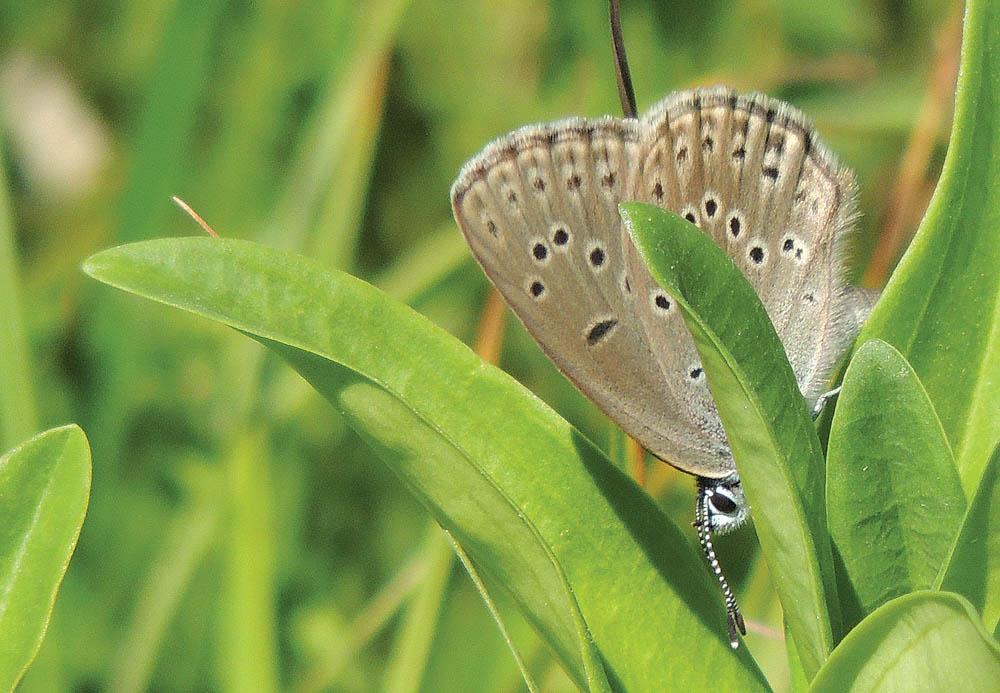
ALCON BLUE (Phengaris alcon)

The Alcon blue has a grey-brown underside of the wings decorated with distinct white spots in the middle of the wings and a series of blurred spots along the outer edge. The eggs are hatched on cross gentian, which thrives on unfertilised hill grassland. The caterpillars feed on the ripening fruits of the gentian until the first moult, when they descend to the ground and start emitting a scent (pheromone). If red ants are around, they detect the smell (the same smell as their larvae in the anthill), transfer the caterpillar to their larvae, and also feed it. Fertilisation of meadows, early mowing (not suitable for gentian), and spring cleaning (destruction of anthills) are the reasons why the species is becoming increasingly rare and consequently protected.

sviščev mravljiščar

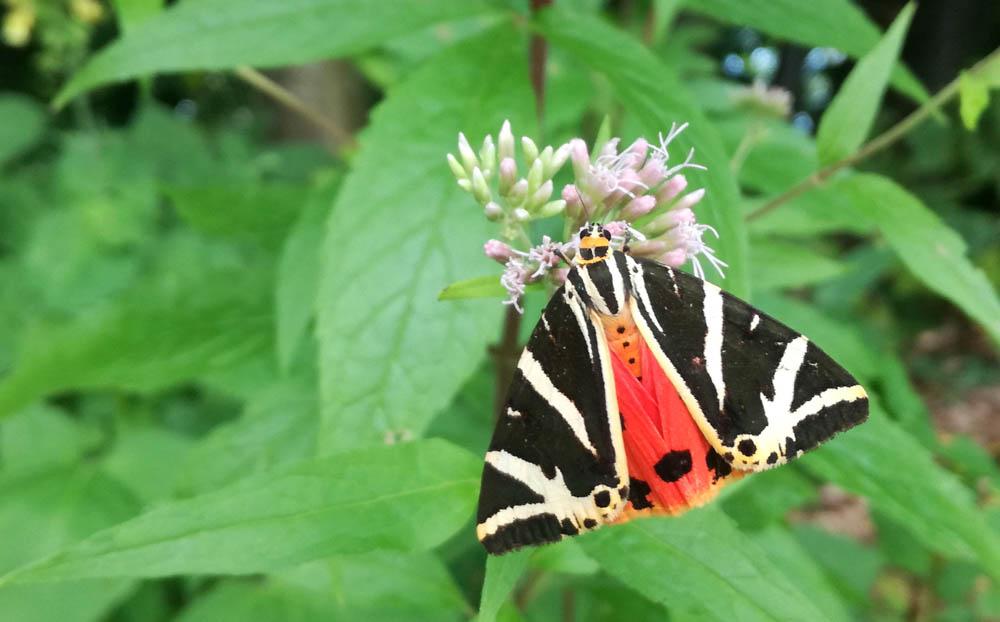
JERSEY TIGER (Euplagia quadripunctaria)

A common summer (July to August) species found in forest clearings, along forest paths. It can most often be observed while feeding or resting on flowering hemp-agrimony. Although it is a nocturnal butterfly (false owlet moth), it is also active during daylight hours.

CRTASTI MEDVEDEK

COMMON BRIMSTONE (Gonepteryx rhamni)

Usually, the first butterfly seen in spring, but mistakenly called the “copper” by many. At the end of winter, we see common brimstones that have overwintered. In June, the next generation can already be seen. Males are vivid yellow, while females are a much paler greenish yellow. The caterpillars feed on the leaves of the alder buckthorn or European buckthorn.

CREPUSCULAR BURNET (Zygaena carniolica)

Burnets are nocturnal butterflies that are active during daylight hours, although there are many more predators active then. They are extremely venomous due to their potassium cyanide-like content. They warn of their venom with their colour (warning colour). The crepuscular burnet was described by the famous J. A. Scopoli during his time in Idrija. They can be seen in sunny, unfertilised, and flowery meadows. The also venomous caterpillars feed on legume plants (trefoil, sainfoins).

kranjski ovnič

HUMMINGBIRD HAWK-MOTH (Macroglossum stellatarum)

When watering flowers on a windowsill in summer, many people notice a hummingbird-like moth. While hovering in front of the flowers, it sucks honey from them with an extra-long sucker. It is a nocturnal member of the moth family, but also flies in daylight. Other moths (the convolvulus hawk-moth, pine hawk-mot, privet hawk moth, elephant hawk moth, etc.) have the same feeding pattern.

BEETLES


At the moment, 350,000 species of beetles from around the world have been recorded (Europe: 8,000, Slovenia: 6,000 species), which is approximately forty per cent of all insect species and a quarter of all animal species recorded. The first publication systematically dealing with beetles in Slovenia was written by Scopoli (Entomologia carniolica, 1763). Coleopterology (science on beetles) in Slovenia increasingly developed with the description of the Leptodirus beetle, the first cave beetle in the world, which was discovered by Luka Čeč in 1831 in the Postojna cave. Undoubtedly, two of the most well-known beetle species are the Rosalia longicorn, one of the first protected and one of the biggest beetles in Slovenia, and the stag beetle, the biggest beetle in Europe.

STAG BEETLE (Lucanus cervus)

rogač

It is Europe’s largest beetle. Adults reach a length of 25 to 85mm. It was named after the enormous mandibles of males that resemble stag horns (in Latin cervus = stag). They are used for ritualized combat for both territory and females. They are active at dusk in summer months when the males fly around making a low-pitched buzzing noise looking for females. They take four years to mature. The larvae drill through the rotten wood of dead and dying trees. Afterwards, they pupate in the ground for three months before emerging as adult animals. Adults feed on plant juices, which they get by cutting into bark using their mandibles. Due to the excessive removal of dry wood from forests, the species has become rare – which is why it is protected by Slovenian and European legislation (a Natura 2000 species).

ALPINE LONGHORN BEETLE (Rosalia alpina)

alpski kozliček

It is a representative of the longhorn beetles and measures from 15 to 38mm in length. Its antennae are the same length as the body in females, while being much longer in males. The elytra are flat, with a blue-greyish colour and various black spots, including a distinctive patch in the chest area. The antennae and legs are the same colour as its other body parts. This colouration serves as a good camouflage in its habitat, i.e. beech forests up to 1,200m high. The development of the larvae, which takes several years is dependent on dry (dead) beech wood. The drying of logs and beech wood in the forest over the summer is disastrous for the species since the females lay their eggs in this wood. Due to the excessive removal of dry wood from forests, the species has become rare – which is why it is protected by Slovenian and European legislation (a Natura 2000 species).

CAPRICORN BEETLE (Cerambyx scopolii)

It is also known as the small oak Capricorn beetle. The development of its larvae primarily depends on oak trees, but also willow and chestnut trees. Adults can often be found during the day in spring on flowering plants, especially on the flowering black-berried elderberry.

CARABUS GIGAS (Procerus gigas)

orjaški krešič

The humid forest environment suits the carabus gigas. Especially in rainy and cloudy weather, it can be seen foraging for food even in daylight hours. Quite often it can be observed indulging in the remains of a squashed snail in the middle of a path, not minding what is going on around it. However, do not disturb the large and otherwise seemingly peaceful beetle too much. Like all ground beetles, it also has a habit of lifting its sternum when in danger and spraying a foul-smelling and caustic fluid right into the offender’s eye. Protected species.

COMMON LADYBUG (Coccinella septempunctata)

7pika pikapolonica

Our most common type of ladybugs. Both their larvae and adults predate aphids. In the event of a large infestation of aphids, they also respond by rapidly reproducing. It is probably because of the predation of aphids that it has become a symbol of good luck for many people. In recent years, they have been threatened in particular by competition from non-native invasive harlequin ladybugs.

DOR BEETLE (Anoplotrupes stercorosus)

gozdni govnač

Between March and October, the most common earth-boring dung beetle in our country can be seen on forest floors. For food, it looks for animal droppings, rotting fungi, and carcasses. The female lays her eggs on the faeces in the underground tunnels dug (under the faeces), as the larvae feed in the same way.

COMMON GLOW-WORM OF EUROPE (Lampyris noctiluca)

In June and July, you can see the light emitted by glow-worms at night. Both, from flying males and wingless females on the ground. Light is produced in the light-emitting cells of the rump when luciferin is oxidised. Each type of glow-worms has a different light flicker pattern and a different wavelength. Although they are familiar to most people, few people know that they are a type of beetle.

ROSE CHAFER (Cetonia aurata)

zlata minica

One of the most common species of beetle, it inhabits sunny areas from the sea to the high mountains. They feed by eating flowers, sweet fruits, and licking sap on damaged branches and trunks of deciduous trees. The larvae (grabs) live in the decaying wood of old trees, humus, and compost.

APPLE BLOSSOM BEETLE (Tropinota hirta)

Their habitat is grasslands, clearings, and forest edges. They appear in large numbers in spring, when they are seen feeding, especially on dandelion flowers. The larvae in the soil feed on rotting plant debris.

NUT WEEVIL (Curculio nucum)

Just over half a centimetre long beetles with an equally long snout (for males, females have a shorter snout). The larvae live in hazelnuts. If they reproduce heavily, they can also cause a large decline in mature hazelnuts. A very similar acorn weevil develops in acorns, and the chestnut weevil develops in chestnut fruits.

COMMON COCKCHAFER (Melodontha melodontha)

majski hrošč

A very common species in forests, orchards, and meadows in recent decades. The larvae (grabs) live in the soil and can cause damage to vegetation by eating the roots. Wild boar can cause even more damage by tearing up meadows where many grabs have been found. Adults gather during the day in spring (peak in May) on shrubs and trees, where they feed on leaves. At dusk, they swarm.

BATS

Bats are nocturnal animals and the only mammal species capable of active flight. Their front extremities have evolved into wings. There is a special membrane between its extended finger and arm bones as well as its body and rear legs, crisscrossed by elastic fibres and capillaries. In our region, bats feed on insects and other arthropods.

Their excrements – guano – is considered to be an extremely high-quality fertiliser worldwide since it contains a lot of nitrogen and phosphorus, thus acting as a nematicide and fungicide. Bats see exceptionally well. At night, they have no problem catching even the smallest of insects. They have well-developed eyes and good vision, but they are not the main sensory organ for seeing. They have developed a special system that works like sonar. They only emit inaudible ultrasonic pulses (in a frequency range above 20,000Hz) and listen to the echoes as they hit obstacles, thus creating an image of the surveyed environment and the position of their prey – this process is known as echolocation. That way, horseshoe bats can detect even threads as thin as just 0.05mm!

So far, 1,116 bat species have been discovered worldwide, which represents a quarter of all mammals in the world. In Europe, there are only examples of small bats from 32 species, whereas in Slovenia alone, 30 species have been discovered. (Source: https://www.sdpvn-drustvo.si/netopirji/)

Usually, the main reason for people killing or poisoning bats is a prejudice against them. Fear and dirt from bat guano (droppings) or, unfortunately, pure malice are also common reasons for destroying bats near human habitation.

Try to think of bats as your neighbours. They eat a lot of insects that would otherwise be buzzing around your bedroom or munching on your vegetables in the garden. It is also prohibited by law to kill or disturb bats. Bats are among the most endangered animal groups in Slovenia, Europe and elsewhere in the world. Often, they are endangered as a result of human ignorance. By familiarising ourselves with the habits of bats, we can protect them.

The biggest danger to bats are people because they interfere in their living environment, e.g. by destroying their shelters when renovating buildings, preventing their access to buildings by installing nets on openings, with the unsuitable placement of bars on the entrances of caves, disturbances in their shelters (e.g. cave tourism), illuminating the passages in the habitats, and general light pollution, destruction of forests, or through changes of forest management (removal of old hollow trees, destruction of their feeding areas), destruction of crucial linear elements in nature (hedgerows, hedges, isolated trees, etc.), excessive use of pesticides on agricultural surfaces, application of wood preservation agents that are poisonous to mammals in bat sheltering areas.

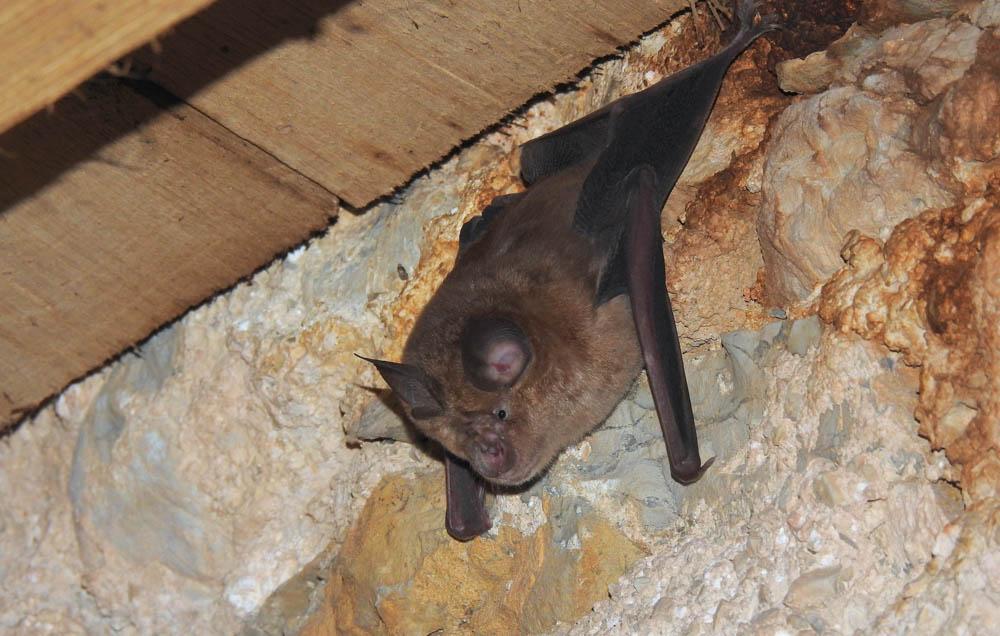
LESSER HORSESHOE BAT (Rhinolophus hipposideros)

A small bat, fully wrapped in its wings, typically hangs from the ceiling when at rest. If you have bats in your attic, this is probably the species you are looking at. It is a slow but skilful flyer, mainly hunting in forests. Its flight paths often pass along linear features in the landscape, such as hedges and forest edges, just a few metres above the ground. During the summer, females live in maternity colonies in warm attics, hibernate in caves, mine tunnels, and even cellars.

mali podkovnjak

MOUSE-EARED BAT (Myotis myotis)

One of Europe’s largest bats, most often seen in warm and spacious attics in summer. They overwinter in other locations (caves, cellars, mines). The back is brown, the belly lighter shades of cream. It usually hunts (picks up prey from the ground) in forests without undergrowth, on fields and mown meadows, pastures and orchards.

navadni netopir

AMPHIBIANS

Today, there are around 6,000 species of amphibians in the world. The study of amphibians (together with the study of reptiles) is called herpetology. The life cycle of most amphibians starts with an aquatic larva that breathes through gills all the way to the adult land animal that breaths with lungs. Amphibians regulate the number of insects, snails, spiders and earthworms since they feed on them. Amphibians are mostly endangered by the destruction of their habitat (drying out and filling up of wetlands), water pollution, the use of chemicals (e.g. pesticides), environmental changes, and the disruptions to migratory routes over roads (amphibians get run over by cars). Recently, experts in Europe and worldwide have noticed that amphibians are dying due to a viral disease caused by a ranaviruses and due to a fungal disease called chytridiomycosis.

Because they are highly endangered, all our amphibians are protected. It is prohibited to kill or poison them or to destroy their living environment, or keep them in captivity.

In the Kozjansko park, we have helped amphibians migrate to their spawning grounds by the Trebče pond every spring since 1999. On both sides of the road, we place a barrier that prevents them from crossing the road. Twice every day (in the morning and in the evening), we manually carry them across the road. We transfer thousands of amphibians every year. The most frequent species is the common toad, but we also deal with the common frog and the agile frog (two species of brown frogs), as well as the smooth newt and the Alpine newt. Every year, the campaign receives help from local schools and interested individuals.

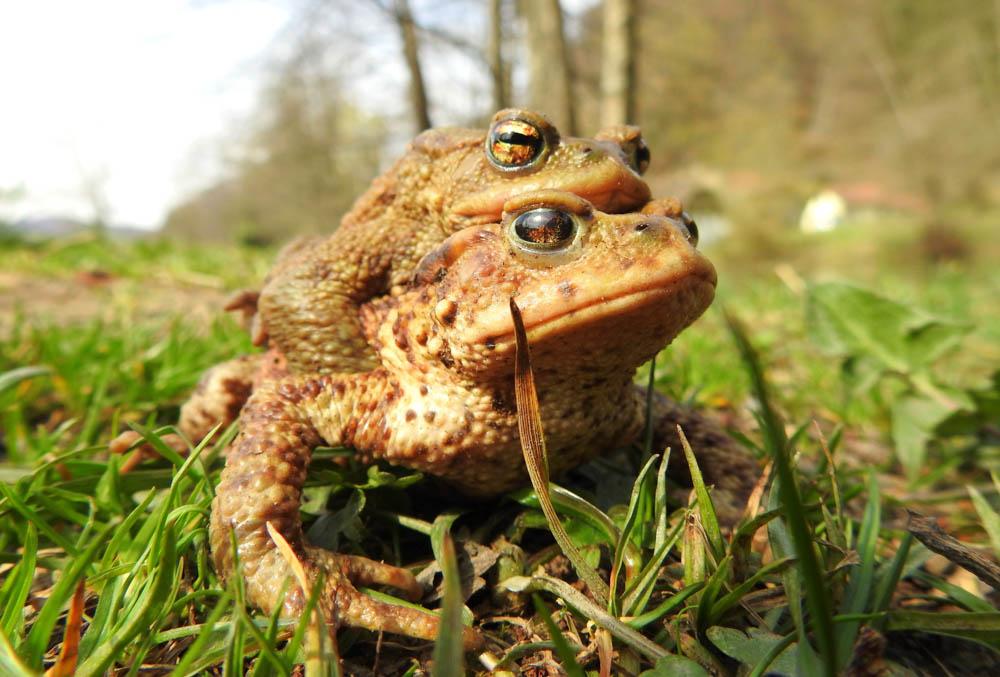
COMMON TOAD (Bufo bufo)

Next to green frogs, it is the most commonly seen amphibian in our area. It spends most of the year on land (forest, scrub, even gardens). It is slow, does not jump, swims well in water. It hunts prey that passes by. It is not picky, and also likes to prey on unwanted invasive snails – the Spanish slug. It has always been associated with witches and witchcraft because of its “scabby” skin.

navadna krastača

COMMON FROG AND AGILE FROG (Rana temporaria, R. dalmatina)

They are representatives of brown frogs, which are very similar. They spend most of their time on the forest floor, where their brown hues make them easy to hide among fallen leaves. In early spring, they go to large ponds, swamps, and other standing waters to set their nets. Agile frog spawns are deposited individually, whereas those of the common frog are deposited in clusters. Introducing fish into water bodies with tadpoles is disastrous for them.

MOOR FROG (Rana arvalis)

A very rare species of brown frog in Slovenia. In the Jovsi and Dobrava area, they are seen every spring during the “frog wedding”. At that time, the brown males turn sky blue. This makes them more attractive to females, but also more visible for predators (otters, herons). Mass photography has also recently become problematic.

EUROPEAN TREE FROG (Hyla arborea)

Despite its small size, the European tree frog is the loudest amphibian. It is able to climb on completely smooth surfaces on its suction-cupped legs. The green colour helps it to hide successfully on green leaf surfaces during the day.

zelena rega

YELLOW-BELLIED TOAD (Bombina variegata)

Yellow-bellied toads live in small forest ponds, including water-filled ruts on forest paths, from spring to late summer. They are named after their quiet call (“oooh – oooh – oooh”). The brown colouring helps them to be inconspicuous in muddy puddles. If caught, it likes to turn on its back and show a warning-coloured belly. The glands on its skin produce toxic substances that would cause serious problems to a predator.

hribski urh

ALPINE NEWT (Ichthyosaura alpestris)

One of the three species of newts in our area. It measures up to 11cm in length. Males and females differ in colouring (males are more colourful, especially during the spring mating season). Despite its name, it is not only found in the Alps, but also in the lowlands. It spends the warmer part of the year in shaded, smaller, standing bodies of water where there are no fish. It overwinters on land, hidden under decaying wood, rocks, moss, or leaves.

planinski pupek,

FIRE SALAMANDER (Salamandra salamandra)

Our most frequently sighted tailed amphibian. They are seen in forests, especially on rainy days. The female does not lay eggs, but keeps them in her body. They only deposit their larvae (tadpoles) in springs or forest streams. Those already have legs, but they breathe with their gills. Many people confuse them with newts. The yellow-black colouring warns us that it is venomous (even fatal to dogs). In Ancient Greece, it was believed to be born of fire – it could hide in decaying wood during the day, and if such wood was used for firewood, the heat would make it try to escape.

navadni močerad

LIFE IN THE WATERS

Kozjansko and Obsotelje are not known for their large rivers or lakes, but the diversity of aquatic life in the Sotla River and its tributaries is immense. Even small puddles in the tracks of forest roads are not lifeless.

DANUBE BARBEL (Barbus balcanicus)

It is a grey-greenish-brown fish up to 20cm long that lives in the bottom of larger streams and smaller rivers. It resembles the common nase, with an overarching upper part of the mouth and two pairs of whiskers. It feeds on soil animals and plankton. It spawns in May and June, when fishing is prohibited

COMMON CHUB (Leuciscus cephalus)

It is a fish of running and standing waters, from areas inhabited by trout to areas inhabited by common bream, moving in all water layers. It is a very common fish species in Slovenia. Common chub eats both animal and plant foods. It can grow to more than 50cm in length. It spawns from April to June, usually in shallow water with a gravel bottom. The sticky eggs are deposited by the female among pebbles and on aquatic plants.

PIKE (Esox lucius)

The head, with its large snout, is somewhat similar to a duck’s bill. It is a predatory species that inhabits both running and still waters. They nest among the vegetation of flooded areas. It is a successful predator of fish, often of its own offspring. Pike fishing is prohibited from February to April, and no specimens under 55cm in length may be taken.

ščuka

RIVER TROUT (Salmo trutta)

It inhabits all Slovenian watercourses in the Danube basin, from large rivers to the smallest streams. It grows up to 50cm, with rare specimens up to 70cm. Adult fish feed mainly on invertebrates, fish, and insects that fly over the water. It spawns from October to February in gravelly areas of streams. Highly threatened by hybridisation with rainbow trout and destruction of watercourses.

potočna postrv

BALKAN GOLDENRING (Cordulegaster heros)

Europe’s largest species of dragonfly, it inhabits forest streams as larvae at the transition between the lowlands and the midlands. The larvae, which are large predators, live on sandy or gravelly bottoms covered with a thin layer of fine organic particles. It is very similar to the sombre goldenring, but a little smaller. Adults are seen between June and August. Protected species.

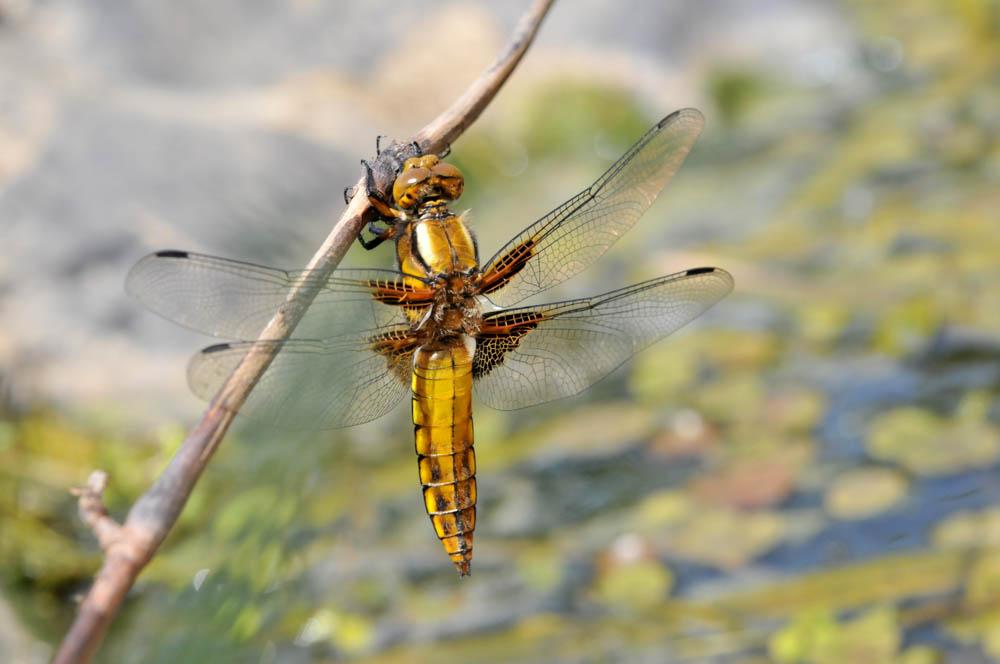
BROAD-BODIED CHASER (Libellula depressa)

A common species of dragonfly. Females and young males have a yellow-brown rump with yellow stripes along the sides, while in adult males, the rump turns grey-blue. It breeds in standing water, preferably in small shallow pools, and also likes small canals and regulated streams. It likes to perch on the tops of stalks by the water, giving it control over its territory and a good hunting ground.

modri ploščec

SMALL PINCERTAIL (Onychogomphus forcipatus)

Adults inhabit the shaded parts of watercourses between May and September. They like to sit on sunny pebbles and rocks by the watercourse where they lived as larvae. The males sit with their backs up and show off their hooked appendages, which are not dangerous to humans as they only use them to “catch” females.

bledi peščenec

BEAUTIFUL DEMOISELLE (Calopteryx virgo)

Our largest damselfly inhabits forest watercourses, darker (and cooler) environments. Where the watercourse widens or the forest thins, it is replaced by the very similar house crow (C. splendens), but their ranges overlap considerably. It deposits its eggs among aquatic vegetation and the roots of riparian aquatic trees in oxygen-rich water. It flies from May to September.

modri bleščavec

STONE CRAYFISH (Austropotamobius torrentium)

It is a typical inhabitant of fast and cold streams and rivers, where it usually hides under rocks. It can also spend the lighter part of the day in “duck’s tunnels”, which are tunnels dug in the soft bank. It rarely grows more than 10cm in length. Its presence is an indicator of the good conservation status of a watercourse and is therefore also one of the priority species of the Natura 2000 ecological network. In addition to water pollution and unwise management of streams and riverbanks, it is also threatened by the introduction of non-native species (competition and transmission of duck plague).

THICK SHELLED RIVER MUSSEL (Unio crassus)

A mussel up to 7cm in size, buried in the bottom of pristine streams and rivers with sandy or gravel bottoms where it lives. Its larvae live like parasites on the gills of fish. After transforming into small mussels, they leave their host and settle in the bed of the stream. Its abundance declined sharply throughout Europe in the 20th century, as a result of pollution of waterways,[6] habitat fragmentation, and declining fish populations in watercourses. Natura 2000 species.

COMMON KINGFISHER (Alcedo atthis)

Because of its bright colours and its diet of fish, it is known in English as the “kingfisher”. It preys on fish from a cover on a branch that extends from the bank above the water. It builds its nest in a tunnel dug in a small vertical wall of the bank or nearby surroundings. It is threatened by a lack of suitable nesting walls, channelling of watercourses, and declining fish populations. Natura 2000 qualifying species.

vodomec

GREY WAGTAIL (Motacilla cinerea)

Breeds in forest and mountain streams and small rivers, avoids open countryside. In recent years, it has followed the example of the related white wagtail and is increasingly nesting on buildings. It can be recognised by the characteristic sway of its long tail. It feeds on insects, which it seeks out on the banks and water surface. In winter, it retreats further south as the water surface freezes.

siva pastirica

MALLARD (Anas platyrhynchos)

Our most common duck species. People usually simply call it a wild duck. Males are very colourful in spring (easier to attract a female), while females are inconspicuous shades of brown so that predators do not notice them when they are hatching and caring for their young. It is the only water bird species that has a hunting season in our country: 1 October–15 January. It can be seen along large and small watercourses (including mountain streams), as well as ponds (including ornamental ponds).

GREY HERON (Ardea cinerea)

The most common species of heron in our country, it can be seen along running and still waters, as well as in fields. It mainly catches fish and amphibians by the water, and small rodents in the fields. It nests in the treetops, usually in groups.

siva čaplja

EURASIAN BEAVER (Castor fiber)

Europe’s largest rodent, hunted by the ancient dwellers in the Ljubljana Marshes (Janez Jalen: Bobri). Unrestricted hunting led to its extinction in our country as well as in much of Europe around 200 years ago. It was again recorded in 1998 on a tributary of the Krka (Radulja), which was a result of reintroduction in the Zagreb area. Today, it inhabits the entire Sotla River and all its lowland tributaries. During the warmer part of the year, it feeds on grassland along the watercourse, and also eats young corn in nearby fields. In winter, it feeds on the bark of thin (young) branches of riparian shrubs and trees, especially willows. It first brings down the trees, “cuts off” all the branches and shortens them to about half-metre lengths so that it can carry them. The branches are used to build a roof over their dwelling and also a dam. The latter is only built on smaller streams at times of low flows.

It contributes to the rejuvenation of woody riparian vegetation by chewing on it. Willows grow quickly and their root systems strengthen the bank against water erosion. Dams ensure that there is more water in the area during dry periods, which is good for aquatic life and for preventing drought in coastal farmland.

OTTER (Lutra lutra)

Queen of our waters. A fast and skilful hunter of fish, amphibians, and mussels. If access to fish farms is not prevented, it takes advantage of it on its hunting missions, of course. In the past, it was almost extinct due to overhunting (it is considered a nuisance species), but after protection, its population has recovered. Each otter owns a section of the waterway where it doesn’t let others in (otherwise it would run out of food). In its territory, it has several dwellings on the banks where it rests during the day. It mainly hunts at night. It cohabits with the beaver because they are not competitors for food. Protected species, also as a Natura 2000 species.

vidra