

NATURAL ATTRACTIONS




24. avgusta, 2024• •
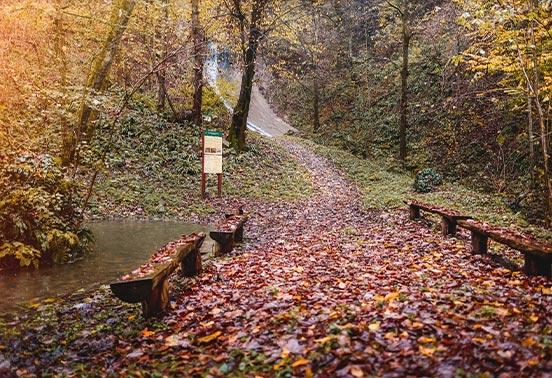
Zelenjak is a gorge of the Sotla River near Kunšperk. It is a hydrological, geomorphological, and ecosystem natural value of national importance.
The Sotla River has cut a 1.5km-long gorge into the Triassic limestone and dolomite below the village of Kunšperk. The steep and wooded slopes are interspersed with numerous rocky outcrops, precipitous cliffs, a natural window in the steep slope, and several karst caves.
The wealth of geodiversity is complemented by a rich biodiversity. Plants include the rare Moehringia bavarica, houseleek, some species of forest orchids, saxifrages, wood burdock, spindle, and many ferns.
In addition to many protected butterflies (the southern festoon (Zerynthia polyxena), Jersey tiger (Callimorpha quadripunctaria) and beetles (the stag beetle (Lucanus cervus), horned beetle (Morimus funerus) and the rosalia longicorn (Rosalia alpina)), the area is also home to birds of prey, owls, woodpeckers, bats, and chamois. Beavers and otters have taken up residence in the Sotla River.
The Bistrica River created an epigenetic gorge in the middle reaches between Trebče and Zagaj when it was trapped by its own alluvium, became embedded in harder, more resistant rocks, and created a deep and narrow gorge that is one of the few that has not been encroached upon by human hands. Some rare and even endangered botanical species grow in the gorge, among others: Carniolan lily, yellow onion, hairy houseleek, yellow whitlow-grass, yellow bellflower, and butcher’s-broom. Interesting representatives of the animal kingdom include scorpions, various dragonflies, amphibians, vultures, chamois, wild boar, while trout and crayfish can be found in the water.
It is protected as a separate geomorphological natural value Zagaj – Bistrica Gorge and as a natural monument.
The gorge covers an area of 408ha (4.08km²), and is the best preserved and most picturesque gorge in the eastern part of Slovenia. The central part of the gorge is impassable, another of the few natural gems that people have to hide from themselves.
The Bistrica Gorge is one of the best preserved and most picturesque river gorges in eastern Slovenia and represents an excellently preserved part of the river biotope. It is of great geomorphological, hydrological, botanical, and zoological importance.
The Lurška Cave below Zagorje is a sinkhole in sandstone of Miocene age (about 20 million years old), up to 38 metres wide and 17 metres high, which is now heavily overgrown with moss and ivy. Water seeps through in several places and collects at the bottom to form small streams. In some places, water seepage through the moss has already led to the formation of tuff.
People attribute the miraculous power of the water that springs here to heal the eyes. About a 100 years ago, a stone altar with a cross and a statue of the Virgin Mary was built under a sandstone overhanging rock in the middle of the forest. In the cliff above the altar were stone steps, which used to be decorated with flowers by school children. Church services, especially vespers, were performed in the Lurška Cave until 1925, when the bishop banned the services. The pilgrims who made the pilgrimage to Our Lady of Mercy in Zagorje also passed through the Lurška Cave.
After the war, the cave was used as a waste dump. The cave has recently been cleaned and the water is suitable for drinking. Today, as in the past, pilgrims once again pass through the Lurška Cave and perform devotions in honour of Our Lady of Lourdes.
The Gruska Cave is the largest, oldest and most important geomorphological natural value of national importance within the protected area.
Located north of Kozje, it is the largest and most distinctive of the pocket valleys. The enclosed end of the valley is a 30-metre-high, vertical wall of lithothamnion limestone. This is a type of limestone that formed in the Tertiary and contains remnants of lithothamnion. Lithotamnias are red algae that used to be deposited in the Pannonian Sea. After death, they turn into crustose and dome-shaped white layers inside the rock. The special structure formed by fossilised algae makes the lithothamnion limestone very interesting, as its composition and structure are indicative of the environment in the sea at that time.
The Gruska stream rises below the wall. The valley is marked by two caves, Gruska (spring) and the Hermit’s Cave.
The Hermit’s Cave is formed in lithothamnion limestones, it is 22 metres long, and has the characteristics of a dry tunnel. The cave was once a spring, and the shape of today’s tunnel is the result of corrosion and erosion.
The Gruska Cave – a spring – is located in a steep cliff at the end of the Gruska Valley. It is a 26-metre-long horizontal tunnel. The entrance to the cave is 5 metres wide and a bit more than a metre high.
Gruska is a beautiful example of a solitary karst phenomenon in Kozjansko. It only occurs where the bedrock is lithothamnion limestone, dolomite and lacustrine limestone.
Quartz sand was washed into the Bizeljsko area millions of years ago by the Pannonian Sea, and a colony of bee-eaters (Merops apiaster) found a home in a quartz sand pit of Bizeljsko. It is an endangered and protected species that has found a suitable nesting site here. The wider area of the abandoned sand pit is a nature conservation value, where the bee-eater’s nesting can be monitored undisturbed from the observatory from the beginning of May until the end of July.
In addition to the bee-eater, local people have also used the quartz sand to their advantage. Due to the specific structure of the sand, caves called repnice were dug in the sand to store turnips and other field produce. The caves have a constant temperature and humidity, which are important factors for the proper binding of silicate particles. The deepest is 12.5 metres long.
Today, repnice are used as unique wine cellars.
Just outside Kozje, the Bister graben stream has carved a narrow valley called Bister graben. Here, animal and plant lovers can observe many interesting specimens. The valley is a very good starting point for further visits along the Castle Trail to the ruins of Kozje Castle, to Vilna peč – a rock outcrop below the summit of Bredič, or from the valley along the slopes of Vetrnik.
On a steep forested slope above the Bistrica River, a picturesque rock named the “Ajdovska žena (Pagan Woman)” was created in granular dolomite after the softer rock had been washed away. It is a geomorphological surface natural monument – a rock outcrop, anthropomorphic in appearance. Ajdovska žena is approximately 12 metres high (approximately 7 metres on the gently sloping side) and approximately 2 metres wide. It reminds of a woman with a child in her arms.
How was the Pagan Woman petrified? The legend of the Pagan Woman is well known in Kozjansko. It says that the pagans, the giants, had to go from Pilštanj to the valley, to Bistrica, to get water, because there was none at Pilštanj. One day, a pagan woman, with her child in her arms, went to the valley once again to get water. The walk back up the steep hill with water in the scorching sun was tiring. She cursed the sun and was petrified as punishment. You will still see her standing there today. Only the child she was clutching to her chest had long ago rolled off her lap and into the valley, leaving her alone, wrapped in the green of the ivy.
Kozjansko Park is an extremely rich place in terms of the heritage of exceptional trees, with at least twelve venerable oaks over 250 years old. The linden in Bizeljsko, the Žuraj oak in Križan vrh, the hollies on Vetrnik, and the plane tree in Kozje are just a few of them. There are also numerous linden trees that are older than 200 years and with a trunk circumference at breast height exceeding 400cm, an extremely old and large service tree, one of the largest yew trees in Slovenia, huge chestnut trees, as well as exotic species, such as extraordinary pine trees, giant sequoias, honey locusts, cryptomeria, sycamore trees, as well as catalpas in the park next to Pišece castle.
Also waterfalls occur in the Kozjansko area, of course on a smaller scale, but in terms of scenic beauty they are often not inferior to the larger and better-known waterfalls. Many smaller hill streams flow down the steep hill slopes of Kozjansko. Where the stream keeps flowing over harder and softer rock, thousands of years of erosion (removal of rock) created larger and smaller waterfalls. In many places, the calcium carbonate excretion on organic (plant and animal) waste has created tufa barriers and waterfalls. Tufa barriers are natural formations created when water rich in calcium carbonate flows over plant and animal remains, gradually leaching the calcium carbonate and forming a hard, rocky layer. Kozjansko waterfalls are mostly hidden in ravines, in hard-to-reach areas.
The best known and most visited are probably the Bohor waterfalls on the southern slopes of Bohor, which is part of the Kozjansko and Obsotelje biosphere area. The themed “Trail of Four Waterfalls” passes by four waterfalls.
A special feature of the Kozjansko region is the solitary karst phenomenon, including sinkholes, dry valleys, springs, swallow holes, caves and abysses. This phenomenon can be found in areas of lithothamnion limestone, which used to be an important construction material since handymen used it to create portals, stones for manual presses and mills. Lithothamnion limestone is a rock derived from fossilised red algae. These algae form solid limestone structures which, over time, turn into limestone that can be used as a building material. The Pustišekova polšna cave is recognised as a Natura 2000 site (SI3000138) mainly because of the bats that inhabit it.
KOZJANSKO REGIONAL PARK Accessibility Statement
We firmly believe that the internet should be available and accessible to anyone, and are committed to providing a website that is accessible to the widest possible audience, regardless of circumstance and ability.
To fulfill this, we aim to adhere as strictly as possible to the World Wide Web Consortium’s (W3C) Web Content Accessibility Guidelines 2.1 (WCAG 2.1) at the AA level. These guidelines explain how to make web content accessible to people with a wide array of disabilities. Complying with those guidelines helps us ensure that the website is accessible to all people: blind people, people with motor impairments, visual impairment, cognitive disabilities, and more.
This website utilizes various technologies that are meant to make it as accessible as possible at all times. We utilize an accessibility interface that allows persons with specific disabilities to adjust the website’s UI (user interface) and design it to their personal needs.
Additionally, the website utilizes an AI-based application that runs in the background and optimizes its accessibility level constantly. This application remediates the website’s HTML, adapts Its functionality and behavior for screen-readers used by the blind users, and for keyboard functions used by individuals with motor impairments.
If you’ve found a malfunction or have ideas for improvement, we’ll be happy to hear from you. You can reach out to the website’s operators by using the following email
Our website implements the ARIA attributes (Accessible Rich Internet Applications) technique, alongside various different behavioral changes, to ensure blind users visiting with screen-readers are able to read, comprehend, and enjoy the website’s functions. As soon as a user with a screen-reader enters your site, they immediately receive a prompt to enter the Screen-Reader Profile so they can browse and operate your site effectively. Here’s how our website covers some of the most important screen-reader requirements, alongside console screenshots of code examples:
Screen-reader optimization: we run a background process that learns the website’s components from top to bottom, to ensure ongoing compliance even when updating the website. In this process, we provide screen-readers with meaningful data using the ARIA set of attributes. For example, we provide accurate form labels; descriptions for actionable icons (social media icons, search icons, cart icons, etc.); validation guidance for form inputs; element roles such as buttons, menus, modal dialogues (popups), and others. Additionally, the background process scans all the website’s images and provides an accurate and meaningful image-object-recognition-based description as an ALT (alternate text) tag for images that are not described. It will also extract texts that are embedded within the image, using an OCR (optical character recognition) technology. To turn on screen-reader adjustments at any time, users need only to press the Alt+1 keyboard combination. Screen-reader users also get automatic announcements to turn the Screen-reader mode on as soon as they enter the website.
These adjustments are compatible with all popular screen readers, including JAWS and NVDA.
Keyboard navigation optimization: The background process also adjusts the website’s HTML, and adds various behaviors using JavaScript code to make the website operable by the keyboard. This includes the ability to navigate the website using the Tab and Shift+Tab keys, operate dropdowns with the arrow keys, close them with Esc, trigger buttons and links using the Enter key, navigate between radio and checkbox elements using the arrow keys, and fill them in with the Spacebar or Enter key.Additionally, keyboard users will find quick-navigation and content-skip menus, available at any time by clicking Alt+1, or as the first elements of the site while navigating with the keyboard. The background process also handles triggered popups by moving the keyboard focus towards them as soon as they appear, and not allow the focus drift outside it.
Users can also use shortcuts such as “M” (menus), “H” (headings), “F” (forms), “B” (buttons), and “G” (graphics) to jump to specific elements.
We aim to support the widest array of browsers and assistive technologies as possible, so our users can choose the best fitting tools for them, with as few limitations as possible. Therefore, we have worked very hard to be able to support all major systems that comprise over 95% of the user market share including Google Chrome, Mozilla Firefox, Apple Safari, Opera and Microsoft Edge, JAWS and NVDA (screen readers).
Despite our very best efforts to allow anybody to adjust the website to their needs. There may still be pages or sections that are not fully accessible, are in the process of becoming accessible, or are lacking an adequate technological solution to make them accessible. Still, we are continually improving our accessibility, adding, updating and improving its options and features, and developing and adopting new technologies. All this is meant to reach the optimal level of accessibility, following technological advancements. For any assistance, please reach out to